The Aesthetic
Kintsugi 金継ぎ: The Art of Golden Repair
Kintsugi mends broken pottery with urushi lacquer and gold — a months-long lacquer craft, not an epoxy kit. What the work involves, and why tea prized it.
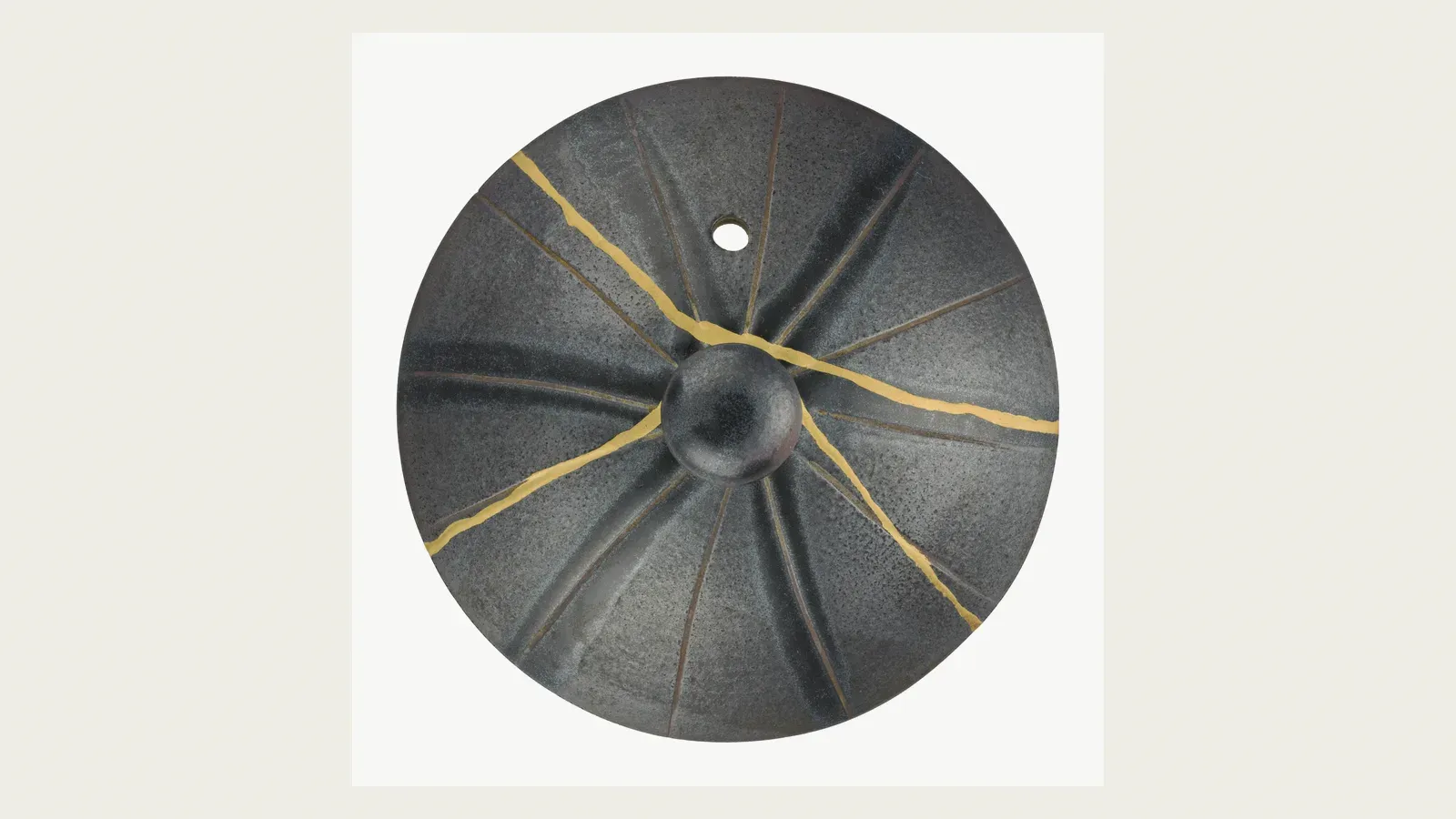
Kintsugi (金継ぎ, “golden joinery”) repairs broken ceramics with urushi (漆, Japanese lacquer) finished in powdered gold. The lacquer is the adhesive and the structure. The gold is only the visible seam. It is a months-long lacquer craft, not the epoxy kit sold as a weekend project.
A celadon tea bowl sits in the Tokyo National Museum under the name Bakōhan (馬蝗絆), “large-locust clamp.” It was thrown at the Longquan kilns in southern China in the thirteenth century, and somewhere in its life its base cracked. In the fifteenth century it belonged to the shogun Ashikaga Yoshimasa, who sent it back to China hoping to trade it for another of equal quality. None could be found. The bowl returned to him fastened with a metal staple, an iron clamp set into drilled holes across the break, and to Japanese eyes that clamp looked like a locust clinging to the glaze, which is how the bowl earned its name.1
Nearly every account of kintsugi opens with Bakōhan, and it rewards a close look, because the clamp on it is the opposite of the tradition it supposedly launched. The staple holds the break shut and draws the eye straight to the failure. The repair Japan became known for made a stranger move. It ran a line of gold down the break and left it there to be seen.
What holds the bowl together
Kintsugi is a lacquer repair. Most popular accounts skip that sentence, and skipping it is why they get everything after it wrong.
The material that binds the pieces is urushi (漆), the sap of the lacquer tree, Toxicodendron vernicifluum.5 Tapped from the trunk in summer and refined, it is the same sap that has surfaced Japanese bowls, trays, and boxes for millennia.5 Lacquer is among the oldest crafts in the country, and by the time anyone thought to mend a tea bowl with it, urushi was already the default coating for anything meant to survive hard use. It behaves nothing like the glue in a hardware-store tube. Urushi does not dry by giving off a solvent into the air. It cures by polymerizing: an enzyme in the sap, laccase, drives the liquid urushiol to knit into a dense film, and that enzyme only works warm and damp, at roughly 20–30 °C and 70–80 percent relative humidity.6 A lacquer worker cures each coat in a muro, a wooden cabinet kept deliberately humid, where a single layer can take days to set.
Raw urushi is a hazard to skin. Urushiol belongs to the same family of oils that makes poison ivy and poison oak a misery, and it raises the same itching, blistering rash on anyone who handles wet lacquer carelessly.6 Cured, the chemistry has turned over completely: the polymerized film is hard, glassy, and inert, which is why lacquerware has carried food and drink safely for thousands of years.
The lacquer is rarely used neat. For a repair it is worked into two pastes, each for a different task.4
- Mugi-urushi (麦漆) — urushi kneaded together with wheat flour and a little water into a stiff adhesive, used to glue the broken edges back together.
- Sabi-urushi (錆漆) — urushi cut with tonoko, a fine polishing clay, into a putty that fills chips, gaps, and missing slivers, then sands flush once it hardens.
The gold comes last, and it is dusted onto the final lacquer as dry metal powder. Once the joins and fills have cured and been sanded smooth, the worker brushes a thin last coat of lacquer along the seam and waits for it to reach a precise tack, no longer wet and not yet hard, then dusts fine gold powder (keshifun) onto it so the metal settles into the surface and locks as the lacquer finishes curing. That dusting is maki-e (蒔絵, “sprinkled picture”), the same method used to decorate fine lacquerware.4 Silver, tin, and platinum go on the same way for a cooler seam, and a silver mend has its own name, gintsugi. The gold is a skin over the repair. The lacquer beneath it is the repair.
That overlap with decoration is the quiet fact under the whole craft. The gilding on a mended seam and the gilding on a luxury writing box are the same skill, laid on the same lacquer, by the same kind of hand. A kintsugi worker is a maki-e worker who happens to be following a crack instead of a drawn design. There is no separate “fixing” trade the technique comes out of. It is fine lacquer decoration, applied to an accident.
Laid out as stages, a plain crack repair — a hibi, with no piece lost — runs roughly like this:
| Stage | Materials | What happens |
|---|---|---|
| Fit and glue | mugi-urushi | The broken edges are cleaned, painted with the wheat-flour lacquer paste, pressed together, bound, and cured in the muro. |
| Fill | sabi-urushi | The clay-and-lacquer putty is packed along the seam to close any gap, cured, and sanded flush. |
| Undercoat | coloured urushi | A coat or two of lacquer seals and levels the mended line, each one cured and smoothed. |
| Gild | urushi + keshifun | A last thin lacquer is brought to tack, dusted with gold powder by maki-e, and cured. |
| Burnish | — | Once fully hard, the gold is polished up to its shine. |
Every stage that reads “cured” means days in the humid cabinet, which is why the whole job stretches the way it does. Rush a coat in dry air and it stays tacky for months, so the muro and the long waits are part of the method itself, and much of what a student spends years learning is how to read when a layer is ready. Each coat has to set before it can be sanded and the next one laid down, and a single piece often passes through ten or more rounds of lacquering, curing, and sanding before any gold appears. A serious repair runs from several weeks to several months. Louise Cort, curator of ceramics at the Smithsonian’s Freer and Sackler galleries, describes the pace plainly: the lacquer must dry and harden, which can take weeks, before it is sanded flush with the vessel and the seams are finally gilded.3
The three kinds of mend
What the break leaves behind decides which repair a piece gets. Conservators sort the work into a few broad forms.4
| Repair | Japanese | What it fixes | What it looks like |
|---|---|---|---|
| Crack | hibi ひび | A fracture with no piece lost | A fine gold line tracing the seam across an otherwise whole surface |
| Piece method | kake 欠け | A chip or fragment gone | The void rebuilt in sabi-urushi and finished so the fill reads as solid gold |
| Bridged join | yobitsugi 呼び継ぎ | A lost fragment replaced from a different pot | A mismatched shard — another glaze, another pattern — grafted in and outlined in gold |
Yobitsugi (呼び継ぎ) is the boldest of the three. A shard from one vessel is fitted into another and joined in gold, so the finished bowl carries two ancestries at once, its glazes refusing to agree. Where the donor shard comes from the same broken object, the join has its own name, tomotsugi.4 A yobitsugi bowl answers anyone who still imagines the aim was to make the damage vanish. On that bowl the mend is the most conspicuous thing there is.
Where it came from
The Yoshimasa story dates the impulse to the late fifteenth century, and Encyclopædia Britannica repeats it as the traditional account: a shogun, a cracked Chinese bowl, disgust at the metal staples that came back, and Japanese craftspeople set to devise something better.2 It is a clean story. Britannica also states that the origin is unknown and that how much of the tale is true is unclear. Take the shogun and the staples as legend, not documented fact.
The firmer evidence points later. Britannica notes that kintsugi was uncommon until after the fifteenth century, around the time the tea ceremony took shape.2 Cort places the practice’s spread in the late sixteenth or early seventeenth century, alongside the rise of the tea bowl as a prized object. The technique grew with the demand for it, so the late-fifteenth-century date belongs to the legend while the documented flourishing arrives a century or so afterward.3 By the Edo period (1603–1868) gold-lacquer repair was an established, named craft, practised on everything from tea bowls to incense containers. A careful page can report both dates, as long as it says which is which.
The earliest documented mention of kintsugi sharpens the tea connection and punctures the romance in the same breath. Cort points to a seventeenth-century warrior, a figure in fashionable tea circles, accused of running a racket: buying plain, dull tea bowls cheaply, breaking them on purpose, having them mended in gold, and reselling them at a fat markup.3 The complaint only makes sense in a market where a repaired bowl fetched more than an intact one. The stronger claim sometimes made, that a warlord might prize a well-mended bowl above a perfect one, is tradition more than record. The racket is the harder evidence for the same taste.
Bakōhan shows the same thing from the other end. Its staples are the foreign fix the tradition set itself against, which makes the bowl a record of the taste rather than the technique: a damaged object kept, named, boxed in Chinese lacquer, and handed down instead of discarded.1
Why tea kept the mended bowl
By the sixteenth century the tea gathering had settled on a taste that ran against display for its own sake. Tea masters prized rough, plain, asymmetric wares, the sensibility later named wabi-sabi: beauty found in the imperfect, the worn, the incomplete. A bowl that had broken and been mended sat easily inside that taste. It came close to the purest thing the taste could point at.
Two ideas meet in a kintsugi bowl. The first is wabi-sabi, and Britannica’s own definition catches it: the gold cracks “serve as a visual record of the object’s history.”2 The mend is the object’s biography written in metal, and a bowl that has come through a break can hold more interest than one that never cracked. The second is mottainai (もったいない), the sense that discarding something still useful is a small disgrace. A cracked bowl in the bin wastes the clay, the throwing, the glaze, the firing, and every year the bowl was in use. Mended, it stays in service and gathers a record of having been cared for. The gold is candid about all of it. It never pretends the bowl is new.
Set that taste against the reflex of most repair. The ordinary aim of a mend is to disappear: a filling colour-matched to the tooth, a darn worked in matching wool, the invisible reweave a good tailor is paid for. European ceramic restoration long chased the same goal, filling and overpainting a break so a visitor never suspects it. Kintsugi inverts the brief. Spending real gold to trace the most fragile moment in an object’s life, and making that trace the most deliberate thing on the piece, is a strange choice, and it is the choice that makes the tradition worth its name.
Tea culture even kept a word for these wares. A bowl that carries an old mend is tsukuroi (繕い), “mended” or “looked after,” and in a tea room the term carries no apology. A gold seam gives a bowl a history a guest can hold, and a host who serves from it hands over that history with the tea.
This is why a mended chawan (tea bowl) can carry more standing in the tea room than a flawless one, and why the same logic runs through the aesthetic of tea and through its close relation mono no aware, the awareness that things pass and move us because they do. None of it calls for a speech from the host. The bowl sits on the mat, broken once and kept, and anyone in the room reads it without a word of explanation. A repaired bowl also asks a little more of its keeper afterward, which is its own small argument for learning to care for teaware properly.
The kit is not the craft
For most people now, “kintsugi” means a boxed home kit, and that kit is a different object from the tradition it borrows its name from.
A typical kit supplies epoxy or another synthetic resin as both glue and filler, plus a metallic powder, often brass, to colour the seam. Handled with care, the result can look the part. But epoxy is not urushi: it sets by a different chemistry in a day rather than curing over weeks in a humid box, and its brass powder only imitates gold. For a vase or a shelf piece, none of that matters.
It starts to matter at the rim.
The seam itself often gives the two away. A real urushi line sits slightly raised and rounded, warm under the gold, and it holds a soft, deep shine once burnished, with a faint translucency where the lacquer thins at the edges. A quick synthetic repair tends to lie flat and glassy, the metal a colder, more even tone, the powder looking mixed into the filler instead of dusted onto a cured surface. Neither read is foolproof, and a skilled epoxy job can fool the eye across a room. The dependable check is provenance: who made the repair, with what, and how long it took.
So the honest division reads like this. The kit on the shelf is a craft afternoon that leaves a gold-coloured line, fine for a vase and a wall. Kintsugi proper is a months-long lacquer discipline, usually learned over years, that hands you back a vessel you can drink from. They share an idea and little else. If you want to do it, the route is a workshop led by someone trained in urushi, and you go in expecting the sap to behave nothing like the resin in the box, and to be treated while wet with the same wariness you would give poison ivy.
Bakōhan still earns the last word. Six centuries on, the metal locust clamped across its base is the first thing anyone sees, and it was only ever meant to hold the broken pieces still. Kintsugi took the opposite bet: draw the break in gold, and let the mend become the most deliberate mark on the pot. One repair kept the bowl usable. The other made keeping the bowl the reason to look.
Sources
7sourcese-Museum, National Institutes for Cultural Heritage (Japan) — Tokyo National Museum
SupportsBakōhan celadon bowl: Longquan ware, Southern Song / 13th c.; Yoshimasa cracked its base, sent it to China, it returned fastened with a staple clamp; named 'large-locust clamp' for the clamp resembling a locust
Encyclopædia Britannica, 'Kintsugi'
SupportsDefinition — lacquer plus a gold or silver metal powder; cracks 'serve as a visual record of the object's history'; origin unknown; late-15th-c. Yoshimasa story flagged as a popular tale of uncertain truth; not widespread until after the 15th c., about the time the tea ceremony developed
Louise Cort (Curator of Ceramics, Smithsonian Freer Gallery of Art & Arthur M. Sackler Gallery), via Artsy
SupportsPractice became commonplace late 16th / early 17th c. with the rise of tea bowls; lacquer used as glue must dry and harden over weeks before being sanded flush and gilded; earliest documented reference is a 17th-c. warrior accused of breaking plain bowls and reselling them repaired in kintsugi
Wikipedia, 'Kintsugi'
SupportsThree repair styles — crack (hibi), piece method (kake), joint-call (yobitsugi); tomotsugi for same-object fragments; mugi-urushi (lacquer + wheat flour), sabi-urushi (lacquer + clay); maki-e dusting; gold, silver, or platinum powder
Encyclopædia Britannica, 'Toxicodendron vernicifluum (lacquer tree)'
SupportsThe Asian lacquer tree; its sap is the source of urushi / Japanese lacquer
GOENNE (urushi and kintsugi materials)
SupportsUrushi cures by enzymatic polymerization at roughly 70–80% humidity, not by drying; urushiol is a potent skin irritant when wet; fully cured urushi is stable and inert
GOENNE, 'Food-safe kintsugi'
SupportsSynthetic-resin / epoxy repairs and 'shin-urushi' / 'cashew lacquer' are generally not food-safe; the word 'urushi' has no legal definition, so a labelled product may contain no lacquer-tree sap
Image: D-Kuru, Wikimedia Commons · CC BY-SA 4.0
Common questions
Is a kintsugi bowl safe to eat and drink from?
A bowl repaired with real urushi lacquer is food-safe once the lacquer has fully cured, because cured urushi is inert — the same reason traditional lacquerware safely holds food and drink. Repairs made with epoxy, synthetic resin, or 'shin-urushi' are generally not food-safe and should be kept away from any surface that touches your mouth.
Can I do kintsugi at home?
You can, but genuine kintsugi is a slow lacquer craft rather than a weekend project. Real urushi cures over weeks in humid conditions and can raise a poison-ivy-style rash while it is wet, so it is usually learned in a workshop with proper handling. The boxed kits sold for home use rely on epoxy and metallic powder; they teach the look, not the technique, and most are unsuitable for tableware.
Is the gold in kintsugi real gold?
In traditional work, yes: fine gold powder or gold leaf is dusted onto a final coat of lacquer. Silver, tin, and platinum are used the same way for a cooler-toned seam, and a silver repair is called gintsugi. Home kits usually substitute brass or bronze powder for the colour at a fraction of the cost.