The Practice
How to Whisk Matcha Properly (The W/M Technique)
Most bad matcha at home is a whisking problem, not a matcha problem. Sift, use cooler water, and whisk briskly in a W from the wrist.
Most disappointing matcha at home is a whisking problem, not a matcha problem. Sift the powder, pour water around 70–80°C, and whisk briskly in a W or M from the wrist, close to the surface of the tea.
Buy a good tin, follow the picture on the back, and the bowl can still come out gritty and bitter, flecked with clumps under a flat grey surface. The reflex is to blame the powder. Usually the powder is fine. What goes wrong happens in the bowl, in about thirty seconds, and it comes down to three things: water straight off the boil, powder that skipped the sieve, and a whisk moved in slow circles. Correct those and the same tin tastes cleaner and sweeter.
This is a home method for usucha (薄茶, “thin tea”), the everyday frothy bowl, as against the thick kneaded koicha (濃茶) of the formal tea room. Usucha is what most people mean by “matcha”: one bowl per drinker, whisked light and drunk fresh 5. Koicha uses far more powder and less water, kneaded into a smooth paste, and is its own discipline, laid out in usucha and koicha. What you whisk matters as much as how you whisk it. A first-flush, stone-milled powder rewards the effort, while a coarse culinary grade stays sharp no matter your wrist, which is the subject of ceremonial versus culinary matcha. The amounts below follow the published usucha recipes of two long-established Kyoto-region houses, Ippodo 1 and Marukyu Koyamaen 3, which agree closely.
What you need
- A chawan (茶碗), the wide tea bowl. A cereal bowl works to start, but width matters: the whisk needs room to sweep flat across a broad floor. A narrow mug jams the tines against the wall. More on choosing one in the chawan.
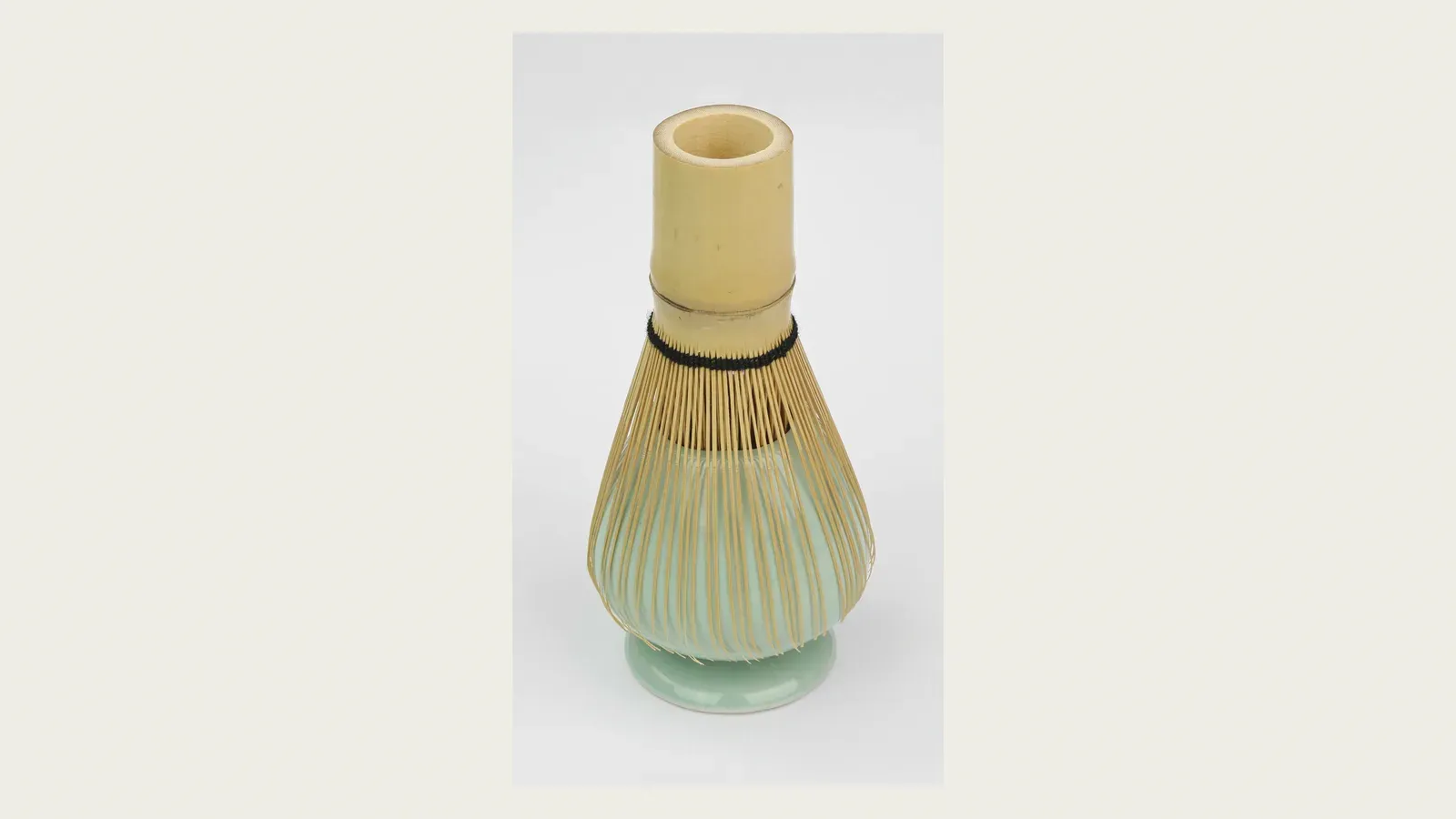
- A chasen (茶筅), the split-bamboo whisk. A usucha whisk carries roughly 80 to 120 fine tines, and the finer, more numerous they are, the more easily they raise a foam. This is the one tool with no real substitute. The detail is in the chasen.
- A chashaku (茶杓), the slim bamboo scoop, or any small spoon. Roughly a heaped scoop and a half makes one serving. See the chashaku and natsume.
- A furui (篩), a fine-mesh sieve, for breaking up the powder. A small kitchen tea strainer does the same job.
- Fresh matcha, and soft water. Marukyu Koyamaen recommends soft water specifically, and hard water flattens the flavour 3. Most Japanese tap water and most bottled water sold as soft mineral water will do. Fresh powder foams better than a tin that has been open for months, which is why storing matcha well is part of whisking it well.
How to whisk usucha, step by step
Six steps, about a minute of work. The order matters more than the numbers.
-
Warm the bowl and soak the whisk. Pour a little hot water into the empty chawan, swirl it, and rest the chasen in it tines-down for ten or twenty seconds. The warm bowl keeps the tea from going cold on contact, and the soak softens the bamboo so the tines flex instead of snapping and their curled tips relax open. Tip the water out and wipe the bowl dry.
-
Sift the matcha into the dry bowl. Measure about 2 g, roughly a level teaspoon or a heaped chashaku and a half, and press it through the sieve into the warm dry bowl. Matcha cakes as it sits, and the lumps will not whisk out. They only break into smaller lumps. Sifting is the step most people skip and the one that most reliably fixes grittiness. Marukyu Koyamaen’s own instructions have you push the powder through a net before any water goes in 3. You can sift ahead into the bowl while the kettle heats.
-
Add the water, off the boil. Pour in about 60 to 70 ml of water at roughly 70–80°C, distinctly below boiling. Without a thermometer, boil the kettle and then pour the water into a separate cup to stand a moment before it goes onto the tea. Both Ippodo and Marukyu Koyamaen cool the water this way 2. The reason is chemical as much as thermal. Hotter water pulls more of the astringent catechins out of the powder, so a near-boiling bowl reads harsh and scorched, while a cooler one keeps the sweetness, the fuller account is in why matcha turns bitter. Nudge toward 70°C for a softer, sweeter bowl and toward 80°C for a brighter, more assertive one.
-
Whisk briskly in a W or M. Hold the chasen loosely and move it fast, back and forth, tracing a W or M across the bowl. Drive it from the wrist and forearm, not the shoulder swinging the whole arm in a circle, and keep the tines gliding near the surface, off the floor. Ippodo describes the stroke as an M shape 2. Marukyu Koyamaen tells you to raise the whisk slightly off the bottom and whip it back and forth, warning in as many words against swivelling the tea around the bowl 3.
-
Whisk for about 15 seconds. That is all it takes. Ippodo puts the stroke at roughly 15 seconds and notes that working quickly holds the aroma better than a long laboured whisk 1. Speed and lightness build the foam. A slow grind will not.
-
Lift the whisk straight up through the centre. Once the surface carries an even fine foam, slow the strokes, draw the chasen gently up through the middle to pop the few large bubbles, and lift it out cleanly. Drink within a minute or two. Usucha does not hold. The foam settles and the tea cools fast.
The motion, explained
The whole technique turns on one thing: shearing air into the tea, fast, near the surface.
A slow circular stir does mix the powder into the water, and it does nothing else. It pushes the liquid around the bowl without dragging air through it, so no foam forms, and the particles stay coarse enough to feel grainy on the tongue. This is why a spoon never quite works, and it is, I’d argue, the reason a lot of people believe they dislike matcha. They have only ever had it stirred, which produces a thin, bitter, gritty cup that tastes nothing like a properly whisked bowl.
The W stroke does the opposite. Each sharp change of direction at the base of the W flicks the fan of tines up through the surface, whipping air into the liquid the way a fork beats an egg white. Dozens of thin bamboo tines slice the tea many times per pass, breaking the clumps down and building a fine microfoam. Keep the whisk shallow and the stroke short and fast, and you can hear it working, a light rattle of bamboo on ceramic. Bury the tines and scrape the bottom, and all you get is stirred green water.
If the foam won’t build, the fault is almost always the wrist. An arm-driven circle is too slow and too deep. Shorten the stroke, speed it up, and lift the tines toward the surface.
How much foam is “right”
Here it helps to know that foam is a school preference, not a quality grade. The major traditions of chadō (茶道, the way of tea) disagree about the ideal surface on purpose, and each is right within its own form 4.
| School | Usucha surface | Whisking |
|---|---|---|
| Urasenke (裏千家) | A dense, fine foam covering the whole surface | Whisked hard and fast to a thick microfoam |
| Omotesenke (表千家) | Partial foam over pools of deep green, the “pond” style | Whisked lightly; the bare crescent is intentional |
| Mushakōjisenke (武者小路千家) | Little to no foam | Whisked least of the three |
Urasenke is the most widely taught school internationally, so its fully foamed bowl is what most people picture as “real” matcha. Omotesenke leaves a crescent of unfoamed tea showing over the green, sometimes called the pond or lake surface, and considers that the elegant one. Both are correct. As the retailer Tezumi frames it, the amount of foam is a matter of taste: more foam mellows the bitterness and the aroma and gives a softer, creamier mouthfeel, while less foam tastes more direct and reads thinner on the palate 4.
A flat, foamless bowl from an everyday home whisk almost always means a technique fault, not a stylistic choice. The gap between a thin even layer and a thick creamy head, though, is style, and it says nothing about whether the matcha in the tin is any good.
Troubleshooting
Most bad bowls trace to one of five faults, and each has a clean fix.
| Symptom | Likely cause | Fix |
|---|---|---|
| Clumps in the tea | Powder not sifted | Press the matcha through a fine sieve into the dry bowl before adding water |
| Bitter, harsh, scorched | Water too hot, or too much powder | Cool the water to 70–80°C; keep the dose near 2 g |
| Thin or no foam | Too little powder, water too hot, a tired splayed whisk, or too much water | Use about 2 g in 60–70 ml; whisk faster and shallower; replace a worn chasen |
| Gritty on the tongue | Coarse or stale matcha, or a circular stir | Buy fresher, finer powder; whisk in a brisk W, not circles |
| Foam that vanishes in seconds | Under-dosed, or aerated too gently | Add a little more powder; drive the stroke harder from the wrist and drink promptly |
None of this asks for a tea-ceremony background. It asks for a sieve, a little patience with the kettle, and a wrist that learns to move the whisk fast and flat. The starter kit covers the small handful of tools, and the wider home practice is where the bowl becomes an everyday habit.
Fifteen seconds of loose wrist is the whole of it. Listen for the rattle of bamboo on ceramic instead of a slosh, and you will know the bowl is right before you taste it, and know, too, that the tin you were about to blame had nothing wrong with it.
Sources
5sourcesIppodo Tea (Global)
SupportsUsucha recipe: 2 g matcha (1.5 heaped ladles / 1 level teaspoon), 60 ml water at 80°C, sift first, whisk vigorously 15 seconds; preparing quickly preserves fragrance
Ippodo Tea (USA)
SupportsSame usucha recipe at 80°C/176°F; pour boiling water into a teacup to cool it to 80°C first; whisk vigorously 15 seconds in an M shape
Marukyu Koyamaen
SupportsSift matcha through a net into a prewarmed dry bowl; use soft water boiled once then cooled (75–85°C in winter); raise the chasen slightly and whip back and forth with wrist and arm, avoiding swivelling, until a fine creamy foam forms
Tezumi
SupportsUrasenke favours a thick layer of fine foam; Omotesenke favours partial foam over pools of green; foam framed as personal preference; more foam mellows bitterness and aroma, less foam tastes stronger
Global Japanese Tea Association
SupportsUsucha is thin, frothy, one bowl per guest; koicha is thick and shared from a single bowl
Image: D-Kuru, Wikimedia Commons · CC BY-SA 4.0
Common questions
Why is my matcha not foaming?
Usually one of four things: too little powder (under about 1.5 g won't hold a foam), water too hot (near-boiling water and a tired, splayed whisk both aerate poorly), too much water diluting the tea, or a slow circular stir that pushes the liquid without shearing air into it. Sift about 2 g into 60–70 ml of water at 70–80°C and whisk briskly in a W from the wrist, close to the surface, for around 15 seconds.
What temperature water should I use for matcha?
Around 70–80°C, distinctly below boiling. Producers such as Ippodo and Marukyu Koyamaen center on roughly 80°C and reach it by boiling the kettle, then pouring the water into a separate cup to cool before it goes onto the powder. Cooler water pulls fewer of the astringent catechins out of the leaf, so the bowl tastes smoother and sweeter. Near-boiling water scalds the powder and turns it harsh.
Do I need a bamboo whisk, or will a milk frother do?
An electric or handheld milk frother will foam matcha and works as an honest beginner shortcut. It aerates, but it doesn't shear apart clumps the way a fan of split bamboo does, so sift carefully first. A bamboo chasen produces a finer, more stable microfoam and is the one matcha tool with no true substitute. A fork or a kitchen whisk only pushes the powder around.