The Implements
The Fukusa: The Silk Cloth and Its Folding
The host's silk cloth in chanoyu: its real size and weight, the fukusa-sabaki folding sequence, and what the colour convention can be sourced to.
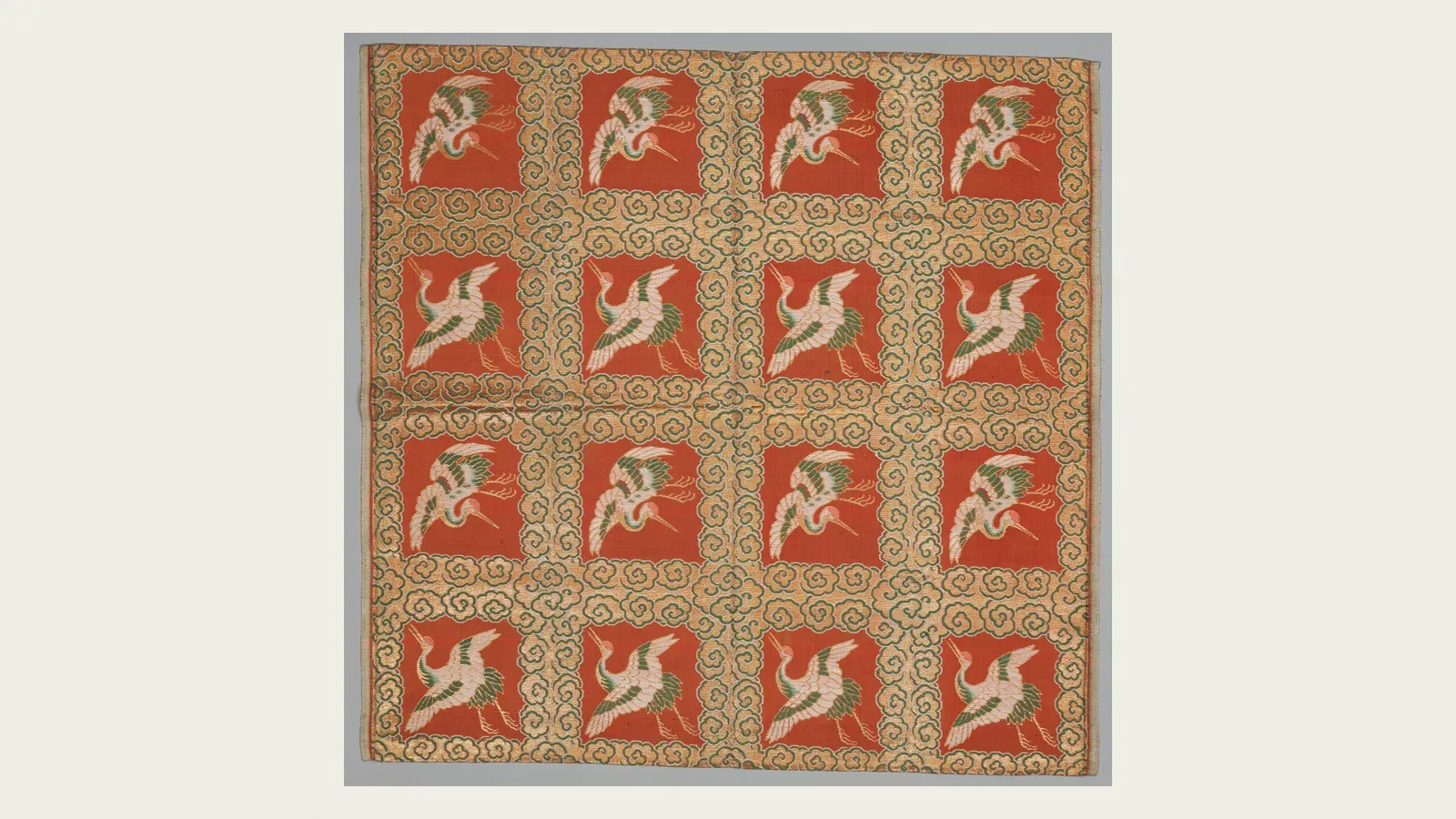
The fukusa is a doubled silk cloth of roughly 27 by 28.5 cm that the host keeps tucked at the waist and folds, in a set sequence called fukusa-sabaki, to wipe the tea caddy and the scoop in front of the guests. It also lifts the kettle’s hot lid. Urasenke teaches the folding from a student’s second lesson.
Type “fukusa” into a Japanese search box and most of what comes back is a wallet. That object is the 袱紗, the pouch you carry a wedding or funeral envelope in, and it takes its name from 袱, a furoshiki wrapping cloth. 15 The tea cloth is written 帛紗, and 帛 means white silk. 15 Same reading, two kanji, and the one on the mat is a thin silk cloth that a host folds five times in every procedure. 1
The utensil glossary gives it a line and a colour rule. The line is right. The colour rule turns out to be the hardest thing on this page to source, and we will get to it.
The cloth, measured
Start with the fact that survives every source: the fukusa is not square.
It runs about 27 by 28.5 centimetres. Prof. Allan Sōsei Palmer, who has studied in the Urasenke tradition since 1972, gives the proportion as 9 by 9.5 sun on the carpenter’s rule — 27.3 by 28.8 cm. 1 An Omotesenke practitioner’s site lists 27.5 by 28.4. 12 A retailer states 27.5 by 28 with a tolerance of half a centimetre to one. 14 The tea master Kimura Sōshin gives it in the old units as hachi-sun hachi-bu no kyū-sun yo, “nine-odd sun by eight sun eight bu,” and reads the pairing as an odd number against an even one, nine being the number at which yang reaches its limit. 7 Take that last part as a teaching rather than a specification. The measurable claim underneath it is that the two edges differ by about a centimetre, and the sources cannot even agree which of them is longer.
Now the part almost nobody mentions. A fukusa starts as a rectangle roughly one shaku by two, folded in half and hemmed on three sides. 1 So the finished cloth is two layers thick, closed along one edge by the fold and sewn along the other three. That fold has a name, the wa-sa (わさ), the seam-free edge, and the sabaki is built around it: the cloth is held with the wa-sa facing right, and every subsequent fold is oriented from there. 3 A guest’s small brocade is carried the same way, wa-sa to the right. 8
The silk is usually shioze (塩瀬), a plain weave with a fine crosswise rib, and purple shioze is the general standard. 5 Sencha practice sometimes uses cotton. 5
The monme number is a weight, not a grade
Fukusa are sold by monme (匁), and this is one of the few teaware specs you can check with a kitchen scale. One monme is 3.75 grams. An 8-monme cloth weighs about 30 grams, which is exactly what the retailers list. 13
| Weight | Cloth weighs | How it is sold |
|---|---|---|
| 5 monme | ~18 g | thin; school clubs, first cloths 12 |
| 7 monme | ~25 g | ”easy for a beginner to fold” 14 |
| 8 monme | ~30 g | the volume seller 12 |
| 9 monme | ~33 g | ”intermediate” at one shop, “practice” at another 10 |
| 10 monme | ~37 g | sold on the beauty of the surface 10 |
Heavier silk is stiffer, holds a crease harder, and hangs differently off the fingers. That much is physics. The ladder built on top of it is merchandising, and the shops give the game away by disagreeing. One retailer sells 7 monme as the beginner’s cloth and 9 as the intermediate’s. 14 Another recommends around 9 monme for practice and around 10 for a real gathering, on the grounds that the heavier face looks better. 10 A teaching site puts 6 to 8 in the beginner’s hands and 9-and-up above that. 9
Here is my position, and it costs you money to ignore it: buy the light cloth. A 6- or 7-monme fukusa is easier to fold, and the folding is the entire skill you are buying the cloth to learn. The heavier silk photographs better and fights your thumb. Nobody at the gathering is weighing your cloth.
Fukusa-sabaki: what the hands do
Urasenke puts this second. Lesson one is bowing, walking on tatami, and opening a door. From the second lesson a student is doing wari-geiko, divided practice, and the first thing on that list is 帛紗捌き. 4
At rest, the fukusa is folded diagonally in half twice and tucked under the obi at the left side, a triangle showing. 2 The sequence that brings it out and squares it runs roughly like this — the ordinary, informal (sō) form:
- Draw it. The hanging portion below the obi is grasped, folded upward by about half its length, and pulled forward. 3
- Present it. The cloth comes to the left side, above the left knee, its main fold horizontal and the wa-sa facing right. 3
- Open it. The right hand goes in between the two layers and spreads the cloth into a triangle at about obi height.
- Pinch. The middle, ring, and little fingers of the left hand come over the top of the silk and hold it against the palm.
- Raise. The right hand slides upward, wrist straight, taking the cloth vertical, and the thumb folds the protruding point down.
- Halve it. The right hand brings the cloth horizontal and folds it back to half its length.
- True it. The right index finger traces across from the left edge — the students’ phrase is that you write the character 一 along it — to bring the edges flush.
- Close it. Fold down. What is left is a small four-cornered pad, and it is that pad that touches the caddy.
Five folds, every procedure, every time. 1 There is a more formal register for higher procedures, yohō-sabaki (四方捌き), “four-direction folding,” in which each of the four edges is folded in half in turn so that four edges become eight before the cloth is folded down. 2 The registers run shin, gyō, sō — formal, semi-formal, informal — the same three grades that sort the chashaku’s node positions. 1
Read those eight steps back and count the dirt removed. The fukusa is dry silk, and it meets a lacquer lid and a curl of bamboo that have touched nothing but powdered tea. Eight movements of both hands produce a pad, and the pad then wipes a clean object clean. The folding is the whole event. This is sei (清), purity, the third of the four principles — an instruction about conduct, not a state of mind, and the reason it is third is that the tranquility everyone quotes is what the first three leave behind, rather than a fourth thing to attempt.
What it touches
The fukusa’s list is short and it is all the host’s.
It wipes the natsume and the chashaku — the lacquer caddy and the bamboo scoop, covered together here, because in use they are inseparable. 15 It comes off the waist again to take the hot lid off the kettle. 15 A kama at matsukaze is close to 90°C and its bronze lid has a knob and no insulation, so a folded pad of doubled silk between hand and metal is the plainest engineering in the room. The same cloth wipes the futaoki, the lid rest — one of the three utensils nobody writes about. It wipes a lacquered lid on the mizusashi before the damp linen goes down on it, and leaves a ceramic tomobuta alone, because lacquer belongs to the caddy’s family and gets the caddy’s treatment.
Guests carry one too. Urasenke’s own list of what to bring to a first lesson names the fukusa, a kobukusa, and a fukusa-basami (帛紗挟み) to hold them. 4 A guest’s fukusa stays folded and comes out for handling utensils during the viewing. Purifying is the host’s job. Where each of these falls in the sequence is the temae’s business.
Three cloths, told apart
The confusion here is real and it is usually left standing. Three textiles come onto the mat and they are different materials doing different work.
| fukusa 帛紗 | kobukusa 古帛紗 / dashi-bukusa 出帛紗 | chakin 茶巾 | |
|---|---|---|---|
| Material | silk, usually shioze 5 | brocade — meibutsu-gire or damask 8 | linen or hemp, white 6 |
| Size | ~27 × 28.5 cm 1 | ~15 × 15.9 cm (Urasenke) 8 | ~30 × 15 cm 6 |
| Wet or dry | dry | dry | damp |
| Whose | host (guests carry one, folded) | guest | host |
| Job | wipes caddy and scoop; lifts the hot kettle lid | sits under the bowl and under prized objects | wipes the inside of the bowl |
The chakin is the one people fuse with the fukusa, and the materials settle it. Linen absorbs and silk does not, so the cloth that dries a wet bowl is hemp, woven a shaku wide, cut to 5 sun 5 bu and hemmed down to 5. 6 It is folded to a set form — fukudame or the diagonal chidori — and it wipes the chawan, and that is its whole career. 6
The small brocade is the interesting one, because whether you own it depends on your school. Urasenke uses the kobukusa, about 15 by 15.9 cm — brocade, slightly wider than it is tall, off-square like its big sibling. 8 Omotesenke does not use it at all, and reaches instead for the dashi-bukusa, a larger cloth close to the temae fukusa’s own dimensions. 11 Same purpose, a dignified seat and some protection for what is set on it. 11 It matters most under a bowl of koicha, the thick tea, where the bowl passes between guests.
The colour convention, and what we could not source
Here is the claim you will read everywhere, including on our own glossary: purple for men, red or orange for women.
It is close to right, and it is more specific than that. Men’s purple is the constant. All three Sen schools put men in 紫. 9 The women’s colour is where the schools part, and the difference is one an insider reads instantly:
| School | Men | Women |
|---|---|---|
| Urasenke 裏千家 | purple 紫 | red 赤 9 |
| Omotesenke 表千家 | purple 紫 | vermilion 朱 9 |
| Mushakōjisenke 武者小路千家 | purple 紫 | vermilion 朱 9 |
An Omotesenke practitioner’s site puts the warning in bold type: vermilion, and do not turn up with Urasenke’s red. 12 A retailer describes the gap as orange-leaning against crimson-leaning. 11 These are neighbouring colours and the distinction is the point — the fukusa is one of the things that tells a guest which house trained a host, alongside tempo and whisking style, as the three schools sets out.
Now the honest part. We could not find a school stating this rule in its own published words. Urasenke’s official page listing what a new student must buy does illustrate the fukusa twice, labelled 女性用 and 男性用, so the school clearly ships the distinction. 4 The page’s text does not name the colours. 4 Omotesenke Fushin’an’s site discusses tea dress at length and does not reach the cloth. Every clean statement of the rule we found is a retailer, a teaching site, or a practitioner’s blog. They agree with each other, which is worth something and is not the same as a primary source. Report it as convention, widely and consistently reported, and unverified at the schools’ own front doors.
Two footnotes that cut against the neat table. The Japanese-language encyclopedia entry frames it differently again: purple shioze is the standard, and women “sometimes” use scarlet — for a stated reason that is entirely practical, so that lipstick on the silk does not matter. 5 And Urasenke, the same entry notes, permits gradation-dyed and yūzen-dyed cloths that no gender rule covers at all. 5 We also went looking for the widely-repeated claims that a woman switches to purple with age, or that colour marks a licence, and came back with nothing sourceable. Treat those as unverified. If they are taught, they are taught in rooms and not in print.
If you are buying one
Buy the colour your teacher’s school uses, and ask the teacher before you ask the shop. Buy 6 or 7 monme. Buy real silk — the practice cloths are rayon, fine for a school club and obvious in a tea room.
A cloth that is folded five times per procedure, from a student’s second lesson onward, does not stay neutral. The silk learns. The creases set where the thumb put them, and after a few hundred gatherings a fukusa opens into the shape of its own sabaki whether or not anyone is holding it. 7 The host purifies the caddy with a cloth that has been permanently deformed by the act of purifying the caddy — which is the closest thing in the tea room to a written record, kept in silk, by an object nobody is looking at.
Sources
15sourcesChanoyu Decoded (Prof. Allan Sōsei Palmer), 'Eight-Ten: Fukusa'
SupportsThe fukusa measures '9 x 9.5 sun kane-jaku or 7.2 x 7.6 sun kujira-jaku'; it is 'made of a rectangle 1 x 2 kane-shaku, that is folded in half and hemmed on three sides'; 'In each procedure, the fukusa is folded five times'; shin (formal) and gyō (semi-formal) sabaki distinguished; the author has studied in the Urasenke tradition since 1972
Chanoyu Decoded (Prof. Allan Sōsei Palmer), glossary: 'Fukusa'
Supports'The fuku-sa, 帛紗, cloth-gauze, is a square of silk fabric that is used by the host, tei-shu, 亭主, house-master, to purify utensils'; 'When not being used, the fukusa is folded in half diagonally twice, and tucked under the obi, 帯, sash, to the side'; sabaki covers manipulation of the cloth — four times when examining it, five when folding it; the four edges are each folded in half to approximate 'eight' edges
Chanoyu to wa (Adam Sōmu Wojciński), 'Notes on the Practice of Chanoyu, 6a — Wari-geiko 1: Folding the Fukusa'
Supports'To remove the fukusa, it is grasped and folded upward (roughly by half of the length of what is hanging below the obi), and then pulled forward'; the cloth is held with its main fold horizontal above the left knee and the folded edge (wa-sa) facing right; the fold sequence and the final inverted-V form; wari-geiko 1 covers folding the fukusa, cleaning the chaire and chashaku, folding the chakin, drying the chawan, opening the kama and mizusashi, and handling the hishaku
Urasenke Konnichian (official), 持ち物・カリキュラム ('What to bring / curriculum')
SupportsThe school's own required-items list for a beginning student: 帛紗, 扇子, 懐紙, 菓子楊枝, 古帛紗, 帛紗挟み, 白靴下; the fukusa is illustrated in separate 女性用 and 男性用 images without the colours being stated in the page text; '2回目からは「帛紗捌き」や「茶筅通し」などの割稽古をみんなでします' — fukusa-sabaki is taught from the second lesson
Wikipedia (Japanese), '帛紗'
Supports'今では一般に紫色の塩瀬が用いられる' — purple shioze silk is the general standard; '女性が緋色のものを用いることもあるが、これは口紅などが付着しても差し支えないようにである' — women sometimes use scarlet so that lipstick marks do not matter; '裏千家においてはぼかし染めや友禅染めのものも用いられる'; '材質は絹がほとんどだが、煎茶道では木綿のものが使われることもある'
Wikipedia (Japanese), '茶巾'
Supports'白い麻布を用いることが多い'; '幅1尺に織った白い麻布を長さ5寸5分に裁ち…5寸に仕上げたもの' — roughly 30 × 15 cm; the fukudame and chidori folds; '茶碗を拭き清める目的のもの' — its purpose is wiping the bowl
中川政七商店 (Nakagawa Masashichi Shoten), '茶道の帛紗が正方形でない理由', quoting the tea master Kimura Sōshin
SupportsKimura Sōshin gives the fukusa's proportion as '八寸八分の九寸余' — rectangular, not square; '「九」という数字は、陽の極まる数字というわけです', the odd nine paired against an even 8 sun 8 bu; silk graded '10号、11号' with higher numbers meaning thicker, more tightly twisted thread; '流派によってお点前に使う帛紗の色は定められています'; the cloth takes permanent creases once folded in use
風月 (Fu-getsu), '茶道具の古帛紗の特徴と使い方'
Supports'縦が5寸(約15cm)、横が5寸3分(約15.9cm)と横がわずかに長い小さな布です'; made of 名物裂 or 緞子 brocade; '茶入・茶碗・茶杓・香合などの貴重品を扱う時に使用します'; carried 'わさを右にして縦半分に手前に折り'; '小さい古帛紗は裏千家のみ使用し表千家では使用しません'
School of Tea, '帛紗(ふくさ)とは?意味・色・匁の選び方と基本の帛紗さばき'
SupportsColour table by school — Urasenke: women red 赤, men purple 紫; Omotesenke and Mushakōjisenke: women vermilion 朱, men purple 紫; '男性はどの流派でも紫色が基本ですが、女性は裏千家が「赤」、表千家と武者小路千家は「朱」と微妙に異なります'; 6–8 monme recommended for beginners, 9+ for intermediate and above
スズキの製茶 (Suzuki Tea), '袱紗サイズを迷わず揃えよう'
Supports'約27〜28cm×約27〜28cm' with individual variation such as '縦27.3×横28.2'; '「匁」=絹の重さの目付表現。数字が大きいほど厚みと腰が出やすい'; recommends '稽古用:消耗を想定し9匁前後' and '本番用:10匁前後で面の美しさを優先' — a different weight-to-level mapping from other retailers; Urasenke '男=紫系/女=赤・紫系'
スズキの製茶 (Suzuki Tea), '袱紗表千家と裏千家の違いとは?'
SupportsOmotesenke women '朱系(橙寄り)', Urasenke women '赤系(紅寄り)', men '紫系' in both; the receiving cloth is named 出帛紗 (larger) at Omotesenke and 古帛紗 (smaller) at Urasenke; '名称と大きさの呼び分けが違うだけで、目的は同じく「品位ある受け座と保護」です'
表千家茶道 おもてなしの心, '帛紗(ふくさ)について'
SupportsAn Omotesenke practitioner's page: '朱(女性用)' and '紫(男性用)', with an explicit warning not to confuse Omotesenke's vermilion with the red used at Urasenke; size '縦27,5cm・横28,4cm' for both; weights 5号 ≈18g, 7号 ≈25g, 8号 ≈30g, 9号 ≈33g, 10号 ≈35g, with '8、9号くらいが人気があるようです'
ほんぢ園 (Honjien), product listing: 茶道具 帛紗 正絹 塩瀬 8匁
Supports'8匁(約30g)' — used only to anchor the arithmetic that the monme figure is the whole cloth's weight (1 monme = 3.75 g), not for any claim about quality or grade
ますみ園 (Masumien), product listing: 茶道用帛紗 裏千家 赤 女性用 正絹 7匁
SupportsListed at 27.5 × 28 cm with a stated tolerance of 5 mm to 1 cm; '初心者の方でも捌きやすい厚さです' for 7 monme; the companion listing (fukusa06.html) sells a 9-monme purple men's cloth as 中級者向き — the two together show the weight-to-level labels are the shop's, not a school's
カワカミ ユキヲ (note.com), '帛紗と袱紗の違い'
Supports'袱は風呂敷を意味し、紗は薄い生地の織物を意味する'; '帛紗の帛は白絹や絹を指す言葉で絹でできた薄い織物という意味になります'; the tea cloth is used '茶器や茶杓を清めるために' and '釜の蓋を外したりする際に使用されます'; '縦約28センチ、横約27センチ四方が一般的で流派によって色が異なります'
Common questions
What is the difference between a fukusa and a chakin?
Material and job. The fukusa is silk, dry, roughly 27 by 28.5 cm, and the host uses it to wipe the tea caddy and the scoop and to lift the hot kettle lid. The chakin is linen or hemp, white, damp, and about 30 by 15 cm, and its only job is wiping the inside of the bowl. A silk cloth would not absorb water and a damp linen one would not protect a hand from hot iron. They are two cloths because they are two problems.
Is purple really for men and red for women?
It is the convention every retailer and nearly every teaching site reports, and the schools do print separate men's and women's fukusa. What we could not find is a school stating the colour rule in its own published words. Men's purple is consistent across the three Sen schools. For women the schools differ: Urasenke red, Omotesenke and Mushakōjisenke vermilion. Buy the colour your teacher's school uses.
What does the monme number on a fukusa mean?
It is the weight of the cloth. One monme is 3.75 grams, so an 8-monme fukusa weighs about 30 grams and a 10-monme one about 37. Heavier silk is stiffer and holds a crease harder, which changes how the cloth drapes and folds. It is a specification, not a grade — retailers disagree about which weight suits which level.
Do guests need a fukusa?
Yes, and Urasenke lists one among the items a student must bring to a first lesson, along with a kobukusa and a fukusa-basami to carry them in. A guest's fukusa stays folded and is used for handling utensils when they are brought out to be examined. Purifying with it is the host's work.