The Implements
The Kama: The Kettle and the Wind in the Pines
The spoutless iron kettle of chanoyu: how one is cast, why iron pieces are lacquered into its base to tune the boil, and the Ashiya and Tenmyō lineages.
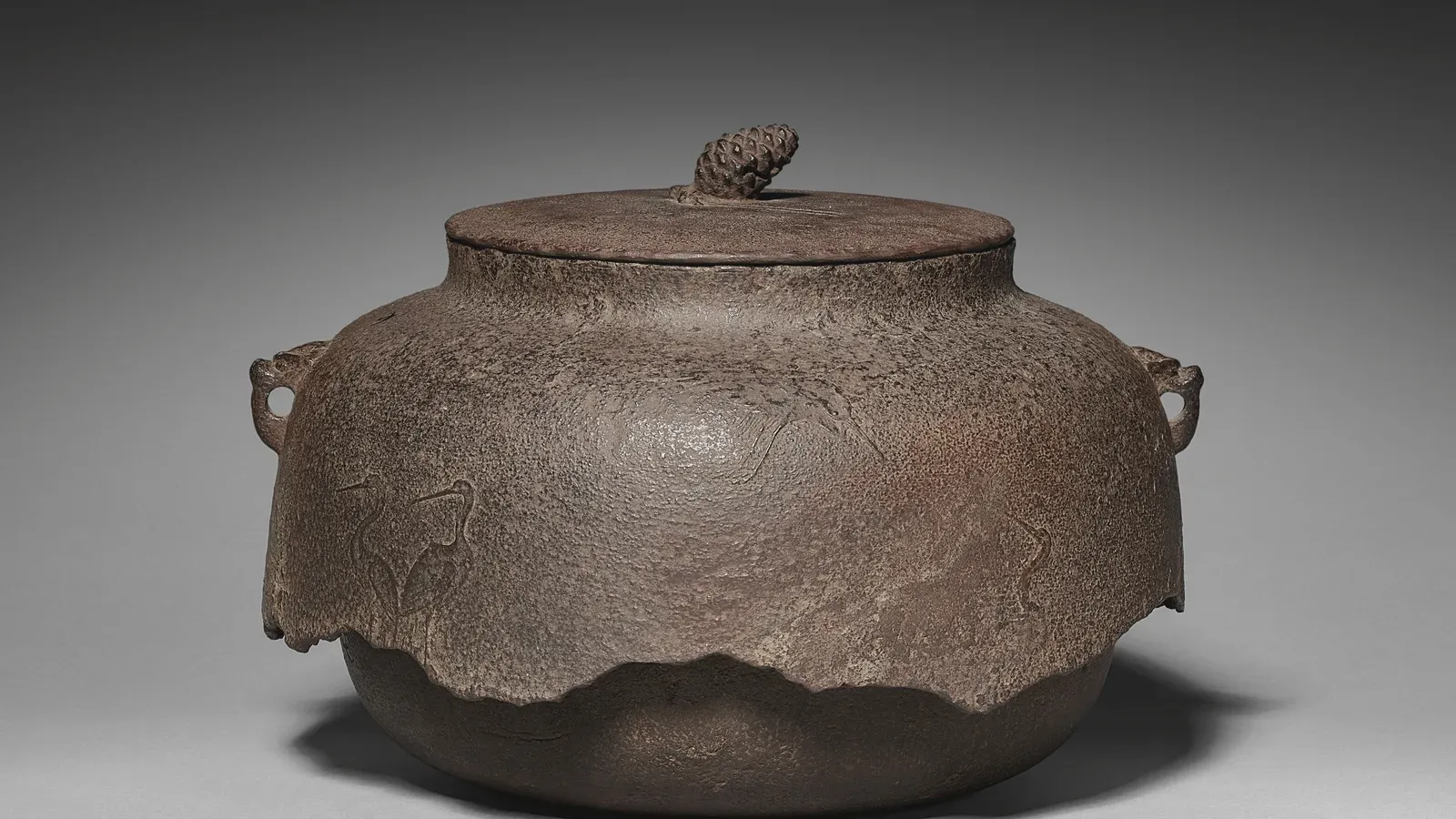
The kama is the spoutless iron kettle at the centre of chanoyu. Water is lifted out of it with a ladle, never poured. Its famous sound, matsukaze, “wind in the pines,” is partly engineered: thin iron pieces called narigane are fixed inside the base with lacquer to tune the pitch of the boil.
In the vocabulary of tea, to host a gathering is to kama wo kakeru (釜を掛ける), “to hang the kettle.” 2 Of the dozen objects a host carries onto the mat, the phrase names the heaviest and the one that never leaves. The bowl is the object the guest touches. The kama (釜) is the object the room is arranged around, and it is the only one making a sound.
Written out in full it is the chagama (茶釜), the tea kettle, though on the mat everyone says kama. It is cast iron, it sits in the fire, and it has no spout, no bail, no lip. Water leaves it one ladleful at a time. That much is the utensil glossary’s short answer, and the spoutless design is where most accounts stop. What follows is the rest: how a kama is made, why it sings, and where the good ones came from.
The kettle you are picturing with a spout and an arched handle is a tetsubin (鉄瓶), a different tool for a different tea, and the tetsubin, tetsukyūsu and kyūsu sort that family out. Note only the direction of descent. The tetsubin is the newer object, scaled down from the ceremonial hearth-kettle by a caster working for a tea-minded lord. The spout was the modification.
How a kama is made
A kama is cast, once, into a mould that is destroyed to release it.
The traditional iron is wazuku (和銑), pig iron smelted in a tatara furnace from mountain sand-iron and charcoal. The Kakutani workshop in Yao, Osaka, buys its wazuku from Okuizumo in Shimane and rates it purer and more rust-resistant than modern iron, and harder to pour. 6 The mould is clay: foundry soil sieved into four grades from coarse to fine, thrown up on a spinning form, then decorated by pressing patterns into the soft surface with shaped spatulas — heraboshi, the stage where a hail-ground or a pine grove gets into the iron before there is any iron. 6
Then the core. The inner mould is built with damp card laid over it so that when the card is stripped, the gap left behind is the thickness of the finished kettle wall: at Kakutani’s bench, around 2 mm at the top and 3 mm at the base. 6 The moulds are dried, sooted, clamped together with iron bands, and the wazuku is poured. The next day the clay is broken off. 6 One mould, one kettle, and the mould does not survive to make a second.
Finishing is where the kettle gets its face. Slow heating over charcoal raises an oxide skin, so it leaves the shop already dark instead of raw, and lacquer mixed with iron oxide and soot goes on against rust. 6 The lid comes last, and most kama take one of bronze — karakane (唐銅) — turned down on a lathe to thickness, coated in thin lacquer, fired glossy black, with a knob of bronze, brass or silver riveted through it. 6 An iron lid cast to match the body has its own name, tomobuta. Either way it comes off hot, which is why the mat needs a lid rest: the futaoki, one of the three utensils nobody writes about.
Matsukaze: the sound, and how it is tuned
Here is the claim that sounds like romance and is a manufacturing step.
The kettle sings well, for pieces of iron are so arranged in the bottom as to produce a peculiar melody in which one may hear the echoes of a cataract muffled by clouds, of a distant sea breaking among the rocks, a rainstorm sweeping through a bamboo forest, or of the soughing of pines on some faraway hill.
Okakura wrote that for an English readership in 1906, and the workshops confirm the mechanical half of it. The pieces have a name, narigane (鳴金), also written 鳴鉄: thin sheets of iron fixed to the inside of the kettle’s floor with a lacquer-and-iron-powder mixture during finishing. 6 Their number and placement set the pitch. Kakutani Yukei, who both makes new kettles and repairs old ones, says an aged kama comes to ring on its own once mineral deposits build up inside it, and that narigane are what give a new or a repaired kettle its voice. Of the fitting, he writes that he tries to place them “like stones on a roji path, like shells scattered on a beach” — casually, not in a row. 7
The physics underneath is ordinary and does not diminish it. Below a full boil, steam bubbles form against the hot iron at the base, break away, and rise into water that is still cooler than the surface they came from. They collapse. That collapse — cavitation — is what a kettle’s noise is. 10 A narigane gives the water a narrow gap of hot iron to boil in and a thin plate to ring against, so the collapses arrive with a pitch instead of as a mush.
Tea tradition counts the whole heat-up as six sounds, kama no rokuon (釜の六音). 8
| # | Sound | Reading | What it names |
|---|---|---|---|
| 1 | 魚眼 | gyogan | ”Fish eyes” — the first small bubbles |
| 2 | 蚯音 | kyūin | The thin cry of earthworms |
| 3 | 岸波 | ganpa | Waves arriving at a shore |
| 4 | 遠浪 | enrō | Surf heard from a distance |
| 5 | 松風 | matsukaze | Wind through a pine grove — the water is ready |
| 6 | 無音 | muon | Silence |
Read the last two lines against the physics. Matsukaze is the fifth stage, and the tradition treats it as the signal that the water is right for tea — one account puts it near 88°C, though the figure varies and should be held loosely. 12 The sixth stage is silence, and a kettle at a rolling boil goes quiet because the bubbles now survive the trip to the surface and stop collapsing. 11 A tea master listening for matsukaze and then hearing the room go quiet is hearing the water pass 100°C — past the temperature matcha wants. Chanoyu named the stage where the noise stops four centuries before anyone wrote down why it stops. The scheme is old and taught, and it comes in more than one version: an alternative set runs 魚眼・蟹眼・雀舌・小濤・大濧・無声, fish-eye and crab-eye and sparrow’s-tongue, borrowed from Chinese tea writing. 8 Treat the six as a teaching tradition rather than a text with a date on it.
Ashiya and Tenmyō
Two places made the classical kettles, and tea people set them against each other in a phrase: Nishi no Ashiya, Higashi no Tenmyō — Ashiya in the west, Tenmyō in the east. 5
Ashiya (芦屋)
Ashiya kettles were cast from around the middle of the 14th century at Ashiya-tsu Kanaya in Chikuzen Province, now the town of Ashiya in Onga District, Fukuoka. 3 They are the refined ones. The standard body is the shinnari (真形), the “true shape”: round, with a belt-like rim running around its lower half. 4 The surface is prized as namazu-hada (鯰肌), “catfish skin,” smooth and faintly lustrous. 3 Over that ground the casters pressed landscapes, birds, plants and geometric figures, or a field of arare (霰), raised hail-dots. 3 The Tokyo National Museum sums the house style as refined form and beautiful patterning. 2
Demand peaked in the late 15th century under the patronage of the Ōuchi clan. Through the 16th century Ashiya kettles thin out of the records, and once the Ōuchi fell the protection went with them; production stopped after 1600, and some of the casters moved to Hakata and worked at other metal. 3 The verdict of the state is lopsided. Of the nine tea kettles designated Important Cultural Properties nationally, eight are Ashiya. 3
Tenmyō (天明・天命)
Tenmyō casting began with weapons. Five metalcasters were moved from Kawachi Province to Sano in Shimotsuke, in the Tengyō era of 938–947, on the orders of Fujiwara no Hidesato, and the craft has run there ever since. 5 Tea kettles came in the Muromachi period, with wabi-cha, and Tenmyō’s appeal was the opposite of Ashiya’s: bold, inventive shapes and a rough, dark, rustic hide of a surface. 2 Where Ashiya is composed, Tenmyō looks like something the ground produced. Records place Rikyū and other powerful men of the period using Tenmyō kettles. 5
Take the designations at face value and Ashiya wins in a landslide: eight of the nine. I would rather own the Tenmyō. Ashiya is the more accomplished object and the safer one, a beautiful thing made beautifully, and eight of nine is a fair reading of that. But the taste that the tea room spent the 16th century arriving at — Rikyū’s taste — was the taste for the rough surface, the accident, the shape nobody planned twice. Tenmyō was already making it, in a foundry town that had been casting weapons for six hundred years and had no theory about any of this. The designations reward the kettles that are hardest to make. The wabi argument is on the other side of the room.
Kyoto
Then the trade moved. Kyoto came up as a kettle centre in the Azuchi-Momoyama era and overtook both older regions 2, and it is still where the tea world’s kettles come from. The address is specific: Sanjō Kamanza (釜座), the old casters’ guild street. The Onishi house has worked that site since Jōrin, roughly four hundred years, and is one of the senke jusshoku (千家十職), the ten craft families that supply the Sen schools. 9 The head of the house takes the name Seiwemon. Their museum on the corner holds some 800 pieces — their own kettles down the generations, alongside the Ashiya and Tenmyō work they measure themselves against. 9
One kettle per hearth
The kama changes with the season, because the fire under it does. A household that practises keeps two: a smaller furo-gama for the warm-season brazier and a larger ro-gama for the sunken hearth. The furo kettle carries a cast flange, the hane (羽), that lets it rest on the brazier’s collar; the ro kettle drops the flange and hangs on an iron trivet in the ash. Swap them and the geometry fails. Why the same room runs two hearths, and why November opens the tea year, is the subject of furo versus ro.
What the kama needs around it is the rest of the water gear: the mizusashi holding cold water to replenish it, the hishaku ladle that moves the water, the futaoki that takes the hot lid — the three utensils nobody writes about. Watch the whole sequence run in a tea procedure.
Should you buy one
No — and the reason is mechanical rather than reverent. A kama has no spout to pour from, no bail to lift it by, and no flat base to stand on an electric ring. It is built to sit in a bed of ash over charcoal, in a hearth cut into a floor or on a brazier, and to be emptied by a ladle that itself needs a rest to lie on. Buy the kettle without the hearth and you own an iron object you cannot use as designed. Buy the hearth without the room and you have a hole in your floor.
Set your budget on the bowl and the whisk. The kama is the object you meet after you have sat a gathering, when a teacher tells you which one and why, and by then you will have heard several.
Okakura’s sentence has been quoted for over a century as the tea room’s most atmospheric line — a cataract muffled by clouds, a distant sea, rain in bamboo. Read it again and notice what it says. Pieces of iron are so arranged in the bottom. He is describing a fitting. Someone chose those pieces, decided how many, and lacquered them to the floor of a kettle where no guest would ever see them, so that the water would sound like a hillside. Kakutani places his the way shells lie on a beach. It is the one part of the tea room built to be heard and never looked at, and it is finished with the same care as the surface a hundred people will admire.
Sources
12sourcesOkakura Kakuzō, The Book of Tea (1906), via Project Gutenberg
SupportsSection IV, The Tea-Room: 'The kettle sings well, for pieces of iron are so arranged in the bottom as to produce a peculiar melody...' — the earliest widely-read English account of the tuned kettle
Tokyo National Museum, 'The Charm of Tea Ceremony Kettles'
Supports釜を掛ける ('to hang the kettle') as the term for hosting a tea gathering; Ashiya kama characterised by refined form and fine patterning, Tenmyō by inventive shapes and rough surfaces; both flourished from the Muromachi period; Kyoto rose as a centre in the Azuchi-Momoyama era and surpassed the earlier two
Town of Ashiya, Fukuoka Prefecture (official)
SupportsAshiya-gama made from around the mid-14th century at Ashiya-tsu Kanaya in Chikuzen Province; shinnari form, namazu-hada 'catfish-skin' surface, arare hail grounds; 8 of the 9 nationally designated Important Cultural Property tea kettles are Ashiya; Ōuchi patronage, decline through the 16th century, production ceasing after 1600; Ashiyagama no Sato museum
Kyoto National Museum, Museum Dictionary: 'About Tea Kettles'
SupportsKettles made in Ashiya, Tenmyō and Kyoto in the 15th–16th centuries; craftspeople of those regions regarded as the best in Japan; shinnari 'true shape' described as round with a belt-like rim around its lower half
Tochigi Prefecture (official), 'Tenmyō Casting', Sano
SupportsFive metalcasters relocated from Kawachi Province in the Tengyō era (938–947) under Fujiwara Hidesato to make weapons; tea kettles from the Muromachi period; rugged, rustic surface prized by tea practitioners; the phrase 'Western Ashiya, Eastern Tenmyō'; Rikyū and warlords recorded using Tenmyō kettles
Kakutani Chūkin Kōbō (角谷鋳金工房), kama-shi, Yao, Osaka — production process
SupportsWazuku (和銑) tatara-smelted pig iron from Okuizumo, Shimane; clay mould sieved to four grades; heraboshi pattern-pressing; core built to give ~2 mm wall at the top and ~3 mm at the base; mould broken the day after pouring; narigane fitted with lacquer at the finishing stage; karakane lid thinned on a lathe and lacquered black
Kakutani Yukei (角谷勇圭), Kakutani Chūkin Kōbō — kettle-maker's column
SupportsThe maker's own account: aged kettles ring as water seeps into mineral deposits inside them; narigane are thin iron sheets lacquered into the base to give new or repaired kettles their sound; he places them 'like stones on a roji path, like shells scattered on a beach'
Wanosuteki (和のすてき), '釜の六音'
SupportsThe six sounds of the kettle — gyogan, kyūin, ganpa, enrō, matsukaze, muon — with matsukaze as the ideal tea-making temperature; an alternative Chinese-derived set (gyogan, kaigan, jakuzetsu, shōtō, daitō, musei); narigane determine the pitch; content credited to Chadō Kankai
Kyoto Museums Association / City of Kyoto — Onishi Seiwemon Museum
SupportsThe Onishi family, beginning with Jōrin, has made chanoyu kettles on the same Sanjō Kamanza site for roughly 400 years; one of the senke jusshoku, the ten craft houses serving the Sen schools; collection of ~800 objects including Ashiya and Tenmyō kettles
Wikipedia, 'Nucleate boiling'
SupportsBubbles form at the heated surface, detach, and 'collapse because the temperature of bulk fluid is not as high as at the heat transfer surface'; 'This collapsing is also responsible for the sound a water kettle produces during heat up but before the temperature at which bulk boiling is reached'
The Naked Scientists, 'Why are electric kettles so noisy?'
SupportsCavitation named as the mechanism: steam bubbles rising into cooler water collapse in on themselves and knock; 'It gets a lot quieter once bubbles get all the way up to the surface and they stop cavitating'
Seattle Japanese Garden, 'The Way of Tea and the Art of Listening'
SupportsMatsukaze as the whistling of the kettle at the last stage before the boil, given as around 190°F, attributed to a thin iron plate set in the kettle floor
Common questions
What is the difference between a kama and a tetsubin?
A kama has no spout and no handle for pouring. It sits in the sunken ro hearth or on the furo brazier and the host lifts water out of it a ladleful at a time. A tetsubin has a spout and an overhead bail and is built to be picked up and tipped. The kama belongs to the matcha ceremony; the tetsubin belongs to sencha and everyday brewing. The tetsubin is also the younger object, scaled down from the ceremonial kettle in Morioka in the 17th century.
What is matsukaze?
Matsukaze (松風), 'wind in the pines,' is the name chanoyu gives the sound of the kettle in the stage just before a full boil. Tea tradition counts six sounds as the water heats, and matsukaze is the fifth, taken as the sign that the water is right for tea. The sixth is silence, which arrives when the water reaches a rolling boil.
Are there really iron pieces inside the kettle to make the sound?
Yes, in most kettles you will hear. They are called narigane (鳴金), thin pieces of iron fixed to the inside of the kettle's base with a lacquer-and-iron-powder mixture during the finishing stage. Their number and placement set the pitch. Old kettles are also said to ring on their own once mineral deposits build up inside them, and makers fit narigane to new and repaired kettles.
Should I buy a kama for making matcha at home?
Almost certainly not. A kama needs a heat source built for it — a sunken hearth or a charcoal brazier — because it has no spout, no bail and no flat base for a stovetop. Without a ladle, a lid rest and somewhere to set them down, it cannot be used as intended. Any kettle that heats water to about 80°C will make better matcha than a kama used wrongly.