The Way
Murata Jukō & Takeno Jōō: Tea Before Rikyū
Rikyū did not invent wabi-cha; he finished it. Jukō turned tea toward plain native wares, Jōō brought the poet's ear, and much of the Jukō legend is late.
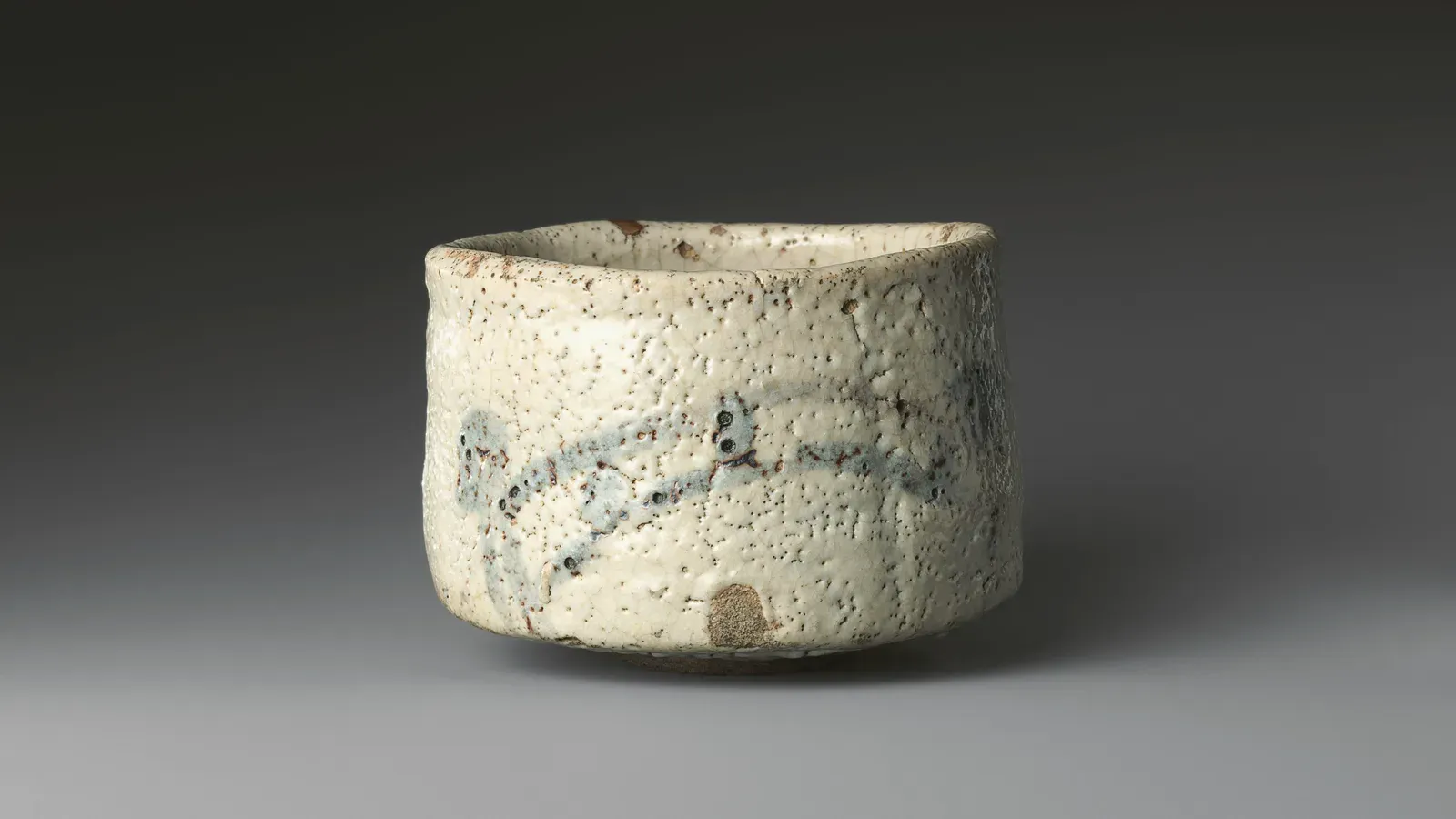
Sen no Rikyū is remembered as the genius of wabi-cha, but two men built it before him. Murata Jukō turned tea toward plain native wares and inward attention; Takeno Jōō brought the poet’s ear. Much of the romantic Jukō story — the Zen master Ikkyū, the shogun’s service, a sacred scroll — is later tradition, and the honest lineage is the better story.
Ask who invented the austere tea of the small room and the plain bowl, and the ready answer is Rikyū. He is the name that survived, and the schools still measure themselves against him. But he inherited a nearly finished aesthetic. The tea histories name three developers of wabi-cha (侘び茶) in sequence — Murata Jukō, then Takeno Jōō, then Rikyū — and even the standard account hedges this as who is “generally credited,” rather than a matter of firm record.2 Rikyū was the third and decisive figure. The first two are the subject here, and the older of them is a study in how little we know.
Murata Jukō, and the trouble with his biography
The dates alone show the problem in miniature. Jukō died in 1502, and that year is stable across the sources. His birth is a three-way disagreement: Encyclopædia Britannica gives about 1422,5 English Wikipedia gives 1423,4 and a Japanese-derived reference gives 1432.3 A decade of uncertainty around a foundational figure’s birth is a fair warning about everything else attached to his name. The records from his own century are few.3
There is a reason the record is thin, and it doubles as a warning about the legend. Jukō was a townsman and monk of the mid-fifteenth century, a generation before tea kept careful documentation of its masters. His fame grew after his death, as the schools that traced themselves to him looked back for a founder worthy of the tradition. A revered origin figure with almost no contemporary paper trail is exactly the condition under which legend accumulates: each later generation, needing him to be more, supplied the details. Read the famous stories with that in mind.
Around that thin core, tradition has built a rich and appealing story. Three of its load-bearing beams deserve to be handled with care.
The first is Zen under Ikkyū. Jukō is traditionally said to have studied Zen at Daitoku-ji under Ikkyū Sōjun (一休宗純), the fierce, unorthodox monk of fifteenth-century Kyoto, and to have drawn from him the conviction that the Buddha’s teaching lives in the way of tea. The traditional English account states it outright.4 The skeptical reading is the more careful one: some researchers doubt the connection, because no firm historical record supports it.3 The relationship may well be true. It is also undocumented, and a page that states it as fact is repeating a story in the voice of biography.
The second is the shogun’s service. Jukō is often said to have served Ashikaga Yoshimasa (足利義政), the eighth Muromachi shogun and the builder of the Silver Pavilion, as a tea master or aesthetic adviser. Current tea-history research disputes this, and the claim traces to the Yamanoue Sōji ki, a tea record written well after Jukō’s death.3 Even the traditional account concedes it is “unlikely to be true.”4
The third is the scroll. The story goes that Ikkyū gave Jukō a piece of calligraphy by the Song Chan master Yuanwu Keqin (圜悟克勤, read Engo in Japanese) as a certificate of his enlightenment, and that Jukō hung it in the tea space — the origin of the Zen scroll in the alcove. The calligraphy is real and survives. Its passage through Jukō’s hands is legend: the contemporary inventories list only a single item as his own, the Jukō tea bowl.3 Everything else attributed to him arrives through later hands.
What holds up
Something firmer remains once the legend is set aside. Around 1488 Jukō wrote a letter to his disciple Furuichi Chōin (古市澄胤), a document known as the Kokoro no Fumi (心の文), the “Letter of the Heart.” It is the one place his own voice reaches us, and it argues against the pursuit of costly, famous Chinese utensils and for a plainer, attentive tea.4 This is the checkable Jukō, and it is enough to place him.
His contribution, stripped of the ornament, was a turn inward and a turn toward the plain. To see the size of that turn, picture the tea it broke from. The fashionable tea of the Higashiyama court — the world of Yoshimasa’s Silver Pavilion — was a display of karamono, prized Chinese objects: celadon, fine temmoku bowls, lacquer, arranged in a formal reception room and admired for their pedigree. Tea there was a setting for treasures. Jukō lifted the modest and the native to standing beside those treasures, and moved the value of the gathering from the price of its objects to the attention of the people in the room. He is credited as the first to bring plainer Japanese implements into serious tea, and the Jukō tea bowl is the object that proves he meant it.3 The road that leads to Rikyū’s rough raku bowl starts here; the chawan is where the native-ware turn becomes something you can hold.
Takeno Jōō, the poet in the merchant
Jōō is the firmer figure, and the documents cooperate. Takeno Jōō (武野紹鴎) lived from 1502 to 1555, a wealthy merchant of Sakai, the self-governing port city that took tea more seriously than anywhere else, and he became the foremost tea master of the town.1 He is the direct teacher of Rikyū — and of Imai Sōkyū, another leading Sakai man — which makes him the hinge between Jukō’s generation and the one that finished the work.
Sakai matters to the story as much as either man. The port grew rich on trade with the mainland and governed itself, comparatively free of the samurai rule that pressed on the rest of the country, and its merchants had both the money to collect fine tea utensils and the independence to decide for themselves what was worth having. Wabi-cha’s turn away from status display was made by men who could have bought any status they liked. That is the setting that produced Jōō, and, a generation later, the fish-merchant’s son from the same town who would carry the aesthetic to its end.
The concrete, documented part of Jōō is his poetry. Until about the age of thirty-five he aspired to master renga (連歌), Japanese linked verse, and he learned the secrets of waka (和歌), classical court poetry, from Sanjōnishi Sanetaka (三条西実隆), one of the great literary authorities of the age.1 He carried that training into the tea room. The wabi sensibility as Jōō shaped it is a poet’s sensibility: an ear for suggestion, for the unfinished and the understated, for the season named by a single image. Where Jukō supplied the plainness, Jōō supplied the tuning, and the aesthetic that reached Rikyū already had both.
What each handed to Rikyū
The honest lineage is a relay. Jukō opened the direction: prize the plain and the native, and judge a gathering by its attention over its treasures. Jōō deepened the mood, gave it a poet’s ear, and taught the young Rikyū directly. Rikyū took a nearly complete aesthetic and drove it to its limit — the two-mat room, the crawl-through door, the raku bowl — with a rigor beyond his teachers. Reading him as a lone inventor gets the shape of the whole tradition wrong; the man belongs at the end of his own story, where the relay finishes, and that story runs back through Jōō and Jukō to the tea Eisai reintroduced three centuries before.
This is why the honest version is the better one. The legend flatters Jukō into a sudden genius handed enlightenment on a scroll by a famous monk. The record shows a careful man who left one letter arguing for a plainer tea, and a poet-merchant who tuned that plainness into an aesthetic — two ordinary lifetimes of work that a third man would make permanent. The Way of tea did not begin with Rikyū, and it is richer for having a real lineage in place of a myth.
Sources
5sourcesWikipedia, 'Takeno Jōō'
SupportsTakeno Jōō (武野紹鴎), 1502–1555; Sakai merchant, foremost chanoyu master of Sakai; aspired to renga mastery until about thirty-five; learned the secrets of waka from Sanjōnishi Sanetaka; teacher of Sen no Rikyū and Imai Sōkyū; followed Murata Jukō as an early proponent of wabi-cha
Wikipedia, 'Wabi-cha'
SupportsThree figures are generally credited with developing the wabi-cha aesthetic, in order — Murata Jukō, then Takeno Jōō, then Sen no Rikyū; the source hedges this as 'generally credited'
Japanese Wiki Corpus, 'Juko MURATA'
SupportsMurata Jukō (1432–1502); records about him are few; some researchers skeptical of the Ikkyū Sōjun connection ('no firm historical records'); current tea-history research disputes the Ashikaga Yoshimasa service; only the 'Jukō tea bowl' is attested in contemporary inventories (the Engo calligraphy is not); the Kokoro no Fumi letter to Furuichi Chōin
Wikipedia, 'Murata Jukō'
SupportsThe traditional English account (birth 1423); asserts study under Ikkyū Sōjun and the Yuanwu/Engo calligraphy as an enlightenment certificate; the Yoshimasa/Ginkaku-ji service recorded only in the later Yamanoue Sōji ki and 'unlikely to be true'; the Kokoro no Fumi (心の文, 'Letter of the Heart') of about 1488 to Furuichi Chōin
Encyclopædia Britannica, 'Murata Shukō'
SupportsInstitutional biography under the reading 'Murata Shukō', giving the birth year as c. 1422; the entry could not be fetched cleanly (403) and is cited only for the date variant and the alternate reading