The Way
Sen no Rikyū (1522–1591): The Man Who Defined Tea
How a Sakai merchant's son codified wabi-cha — the grass-hut room, the crawl-through door, the raku bowl — and why Hideyoshi ordered his death.
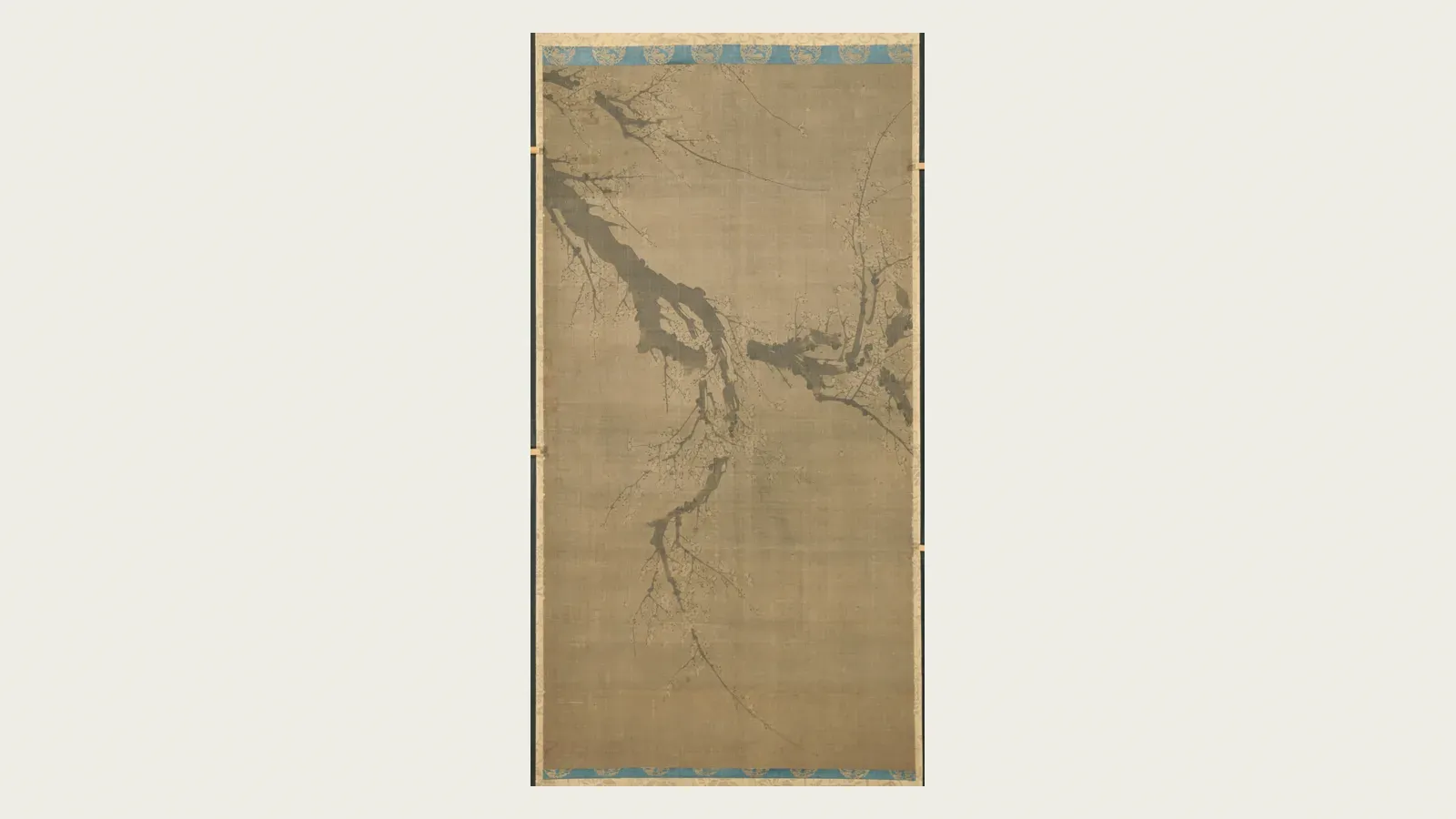
Sen no Rikyū (千利休), a merchant from Sakai, codified wabi-cha (侘び茶): a tiny grass-hut room, common native wares over imported Chinese treasures, and the raku bowl. He served Oda Nobunaga and then Toyotomi Hideyoshi as tea master, and in 1591 Hideyoshi ordered him to commit seppuku. The reasons are still debated.
Most of what people picture when they imagine a Japanese tea ceremony was settled by one man in the second half of the sixteenth century. The small bare room. The rough dark bowl. The low door a guest has to stoop through. Whisked tea and austere gatherings both predate him. Rikyū took a direction his teachers had opened and carried it to a conclusion so complete that four and a half centuries later the tea schools still measure themselves against it. Then the most powerful man in Japan ordered him to cut open his own belly.
A merchant’s son from Sakai
Rikyū was born in 1522 in Sakai (堺), the port city near present-day Osaka, into a wealthy commercial family. His given name was Yoshiro, and the family ran a fish business, a shop called Totoya, alongside warehousing.3 The detail matters more than it looks. Tea had reached Japan through Zen monasteries, and its later cultivation belonged to temples and to the warrior elite. Rikyū came from the merchant town instead. Sakai governed itself, grew rich on trade, sat comparatively free of samurai rule, and its merchants took tea seriously as an art. The man who would strip the gathering of its imported luxury came from exactly the class that could afford that luxury and chose to set it aside.
Even the name we know him by arrived late. Through most of his life he was Sōeki, his Buddhist name. In the autumn of 1585 Hideyoshi arranged to serve tea to Emperor Ōgimachi inside the imperial palace, and a commoner could not appear before the emperor without standing. So the court conferred on Sōeki the lay Buddhist title Rikyū Koji (利休居士), credentials enough to enter the palace and assist.3 He was sixty-three, and had nine years left. It is by that borrowed honorific that four centuries have kept him.
The line he inherited
Rikyū began tea young. Nippon.com puts him at seventeen, studying first under the Sakai master Kitamuki Dōchin and then under Takeno Jōō (武野紹鴎, 1502–1555), the leading tea man of the city.3 Jōō carried forward the line of Murata Jukō (村田珠光, 1423–1502), the monk usually named as the first to turn whisked-tea practice toward austerity under Zen influence. Jukō opened the direction. Jōō, an inheritor of Jukō’s conviction that tea should not be ruled by the prestige of its objects, deepened its mood and drew in the cadence of waka and renga poetry. Rikyū brought it to completion.4
The lineage is the thing to get right, because the idea Rikyū finished was born two teachers before him. He was the third and decisive figure in a chain that began with Jukō, and reading him as a solitary inventor gets the whole shape of the tradition wrong. Here is the arc, from birth to the order to die:
| Year | Event |
|---|---|
| 1522 | Born in Sakai as Tanaka Yoshiro, into a fish-trading family |
| c. 1538 | Studies tea under Kitamuki Dōchin, then Takeno Jōō |
| 1575 | Performs tea for Oda Nobunaga |
| 1582 | Tai-an built; Nobunaga killed; Rikyū enters Hideyoshi’s service |
| 1585 | Granted the name Rikyū to serve tea for Emperor Ōgimachi |
| 1587 | Among the chief advisers at the Grand Kitano tea gathering |
| 1591 | Ordered by Hideyoshi to commit seppuku |
Tea master to two warlords
By the 1570s Rikyū’s reputation had reached the men reunifying Japan by force. In 1575 he performed tea for Oda Nobunaga, the warlord then closest to controlling the country.2 Nobunaga collected famous tea utensils and used them as instruments of rule: granting a prized caddy or bowl could carry the weight of granting a province. When Nobunaga was killed in 1582, his general Toyotomi Hideyoshi seized power, and Rikyū moved into his service as tea master.
The role held real authority. Hideyoshi used tea as Nobunaga had, and Rikyū stood at the center of it, designing gatherings, advising on objects, and shaping the etiquette that warlords were expected to follow. A fish-merchant’s son had become the arbiter of taste for the people running the country, close enough to power that a contemporary letter could split the regime’s affairs in two: confidential matters to Rikyū, official matters to Hideyoshi’s brother.
Their pairing produced one of the strangest contrasts in the history of the form. Hideyoshi, who had risen from peasant origins to absolute power, loved display. He commissioned a portable tea room lined entirely in gold leaf, a room that could be crated, carried on campaign, and reassembled to overawe.7 In 1587, fresh from subjugating Kyūshū, he staged the Grand Kitano tea gathering (北野大茶湯) at the Kitano shrine in Kyoto, a public event of some 1,500 tea sites open to every rank, with Rikyū among its chief advisers. The man whose name stands for the smallest, plainest room helped run the largest, most theatrical tea event of the age. Rikyū’s grass hut and Hideyoshi’s gold are usually told as opposites, and they were. For a time they also ran in harness. That whole collision — tea as an instrument of power — has its own account in warrior tea.
What Rikyū changed
Calling what Rikyū did a “simplification” flattens it. Each of his choices cut deliberately against the prevailing taste, and the specifics are where the man becomes legible.
He shrank the room. The fashionable tea space was a clean four-and-a-half-mat room. Rikyū pushed the other way, to two mats and even to a room of a mat and a half.2 At that scale the room stops being a setting for objects. Host and guest kneel nearly knee to knee, a body’s length apart, and there is nothing to attend to but the tea and each other. This is the small grass hut, the sōan (草庵) style: rough plastered walls, exposed wood, the feel of a farmer’s shelter rather than a noble’s reception hall.
He chose native and common wares over Chinese treasures. The most prestigious tea objects were imports, celadon and fine temmoku bowls and lacquer, and Rikyū kept some. But he lifted the plain and the local to equal standing: a section of bamboo cut into a flower vase, a well-bucket pressed into service as a water jar, unglazed Japanese stoneware. A humble object, rightly seen, could hold more than an expensive one.
He commissioned the raku bowl. Working with a Kyoto tile-maker named Chōjirō (長次郎), Rikyū had bowls made to his own conception: hand-formed rather than thrown on a wheel, low-fired, thick-walled, dark, a little irregular.2 These were called ima-yaki, “today’s ware,” at first. The name raku (楽) came afterward, from a gold seal bearing that character, which Hideyoshi took from his Jurakudai palace and granted to Chōjirō’s successor. The Raku family has carried the name ever since.6 The bowl is the aesthetic made physical, a vessel that warms in the hands, sits a touch off-square, and looks made by a person. To follow the line from his conception into your own hands, start with the whisk — see how to whisk matcha.
He fixed the crawl-through door. The nijiriguchi (躙口) is a square guest entrance barely two feet on a side, so low that a person must kneel and shuffle through head-first. A long sword cannot pass it, so a samurai left his blade on a rack outside. The tradition reads the design as a leveller: everyone who enters is bent to the same posture, whatever their rank. That reading is widely repeated and it is an interpretation of the door, not a line Rikyū wrote down, so take it as the tradition’s sense of the threshold. The room it opens into gets its full reading in the chashitsu.
Underneath all of it is the sensibility the West later learned to call wabi-sabi, beauty found in the plain, the worn, and the imperfect. Rikyū did not coin that compound, and he left no tidy manifesto. What he left was a redefinition of the procedure, the utensils, the teahouse, and the garden, a set of things consistent enough that the philosophy reads directly off them.1
Tai-an: the one room that survives
Of the tea rooms Rikyū designed, one survives that is firmly attributed to him: Tai-an (待庵), built in 1582 at the Myōki-an temple in Yamazaki, between Kyoto and Osaka.5 It is a two-mat room, about three square meters, with earthen walls, a small alcove, and the low crawl-in door. Japan designates it a National Treasure.
Two honest caveats travel with it. The attribution rests largely on the temple’s oral tradition rather than on contemporary documents, and the exact year is not beyond dispute.5 And the room is tiny in a way photographs cannot convey: the host kneels a body’s length from the guest, in a floor space narrower than most modern bathrooms. Stand inside and the argument of the whole aesthetic is there in the dimensions.
What he taught, and how we know it
Rikyū wrote no treatise. His teaching came down through disciples, and the fullest record of it, the Nanpōroku (南方録), is also the most fraught. It is attributed to his disciple Nanbō Sōkei, but it surfaces only in 1686, transcribed by a Fukuoka retainer named Tachibana Jitsuzan roughly a century after Rikyū’s death, and scholars have long argued over how much of it is Rikyū and how much is Jitsuzan.8 The text sits at the center of the tea canon and cannot be read as a stenographic transcript of the master. Anyone who quotes the Nanpōroku as Rikyū’s direct words is trusting a document that reached paper generations too late.
The same caution attaches to the four principles most often hung on his name, wa-kei-sei-jaku — harmony, respect, purity, tranquility. The living schools teach them as Rikyū’s. Scholars date the exact phrase later. The teaching is central to chadō, and its precise authorship is unsettled, and both of those can be true at once.
Two stories that are not quite history
Two anecdotes cling to Rikyū more tightly than most verified facts, and both are best told as what they are: tradition, not documented event.
The first is the morning glories. Rikyū’s garden of them was famous, and Hideyoshi asked to see it. When he arrived, every flower had been cut. Puzzled, he entered the tea room, and there in the alcove stood a single morning glory in a vase. The story turns on subtraction: one perfect bloom against a vanished field. It illustrates his method cleanly, and it has grown in the retelling, with no contemporary record to anchor it.
The second comes down through Okakura Kakuzō’s The Book of Tea. Rikyū watches his son sweep the garden path. The boy sweeps it spotless, three times over. Not clean enough, Rikyū tells him — then steps into the garden, shakes a tree, and scatters a few autumn leaves across the swept ground.9
What Rikiu demanded was not cleanliness alone, but the beautiful and the natural also.
A real text records that one, but it records a tradition told to make a point. The lesson is sound. The history is soft. Both deserve the qualifier.
The order to die
In 1591, at seventy by the traditional count, Rikyū received an order from Hideyoshi to commit seppuku (切腹), ritual suicide by self-disembowelment, and he carried it out at his residence in Kyoto.3 The traditional date is the twenty-eighth day of the second month of Tenshō 19, which Nippon.com renders as April 21.2 This was a command from his lord to kill himself. Refusing was not a choice a retainer had.
Why Hideyoshi gave it is one of the genuine open questions of the period. No surviving document states his reasons plainly, and several explanations circulate.
The most-told is the Daitoku-ji gate. Rikyū had funded repairs to the Sanmon gate of the Zen temple he was tied to, and the monks placed a wooden statue of him in the upper story, shod in sandals. Anyone passing beneath the gate, Hideyoshi included, would walk under a tea master’s feet, read as intolerable arrogance.3 The statue was destroyed and Rikyū’s severed head later displayed there. It is the cleanest narrative, which is one reason to be wary of it.
Then there is the court politics. Rikyū had gathered enormous influence over the warrior elite, and a merchant wielding that kind of soft power was a liability to a regime consolidating absolute control. Accounts add that he was charged with profiteering by appraising and reselling tea utensils, that the official Ishida Mitsunari maneuvered against him, and that he had refused to send his daughter to Hideyoshi.3 And there is the clash of taste itself, the gold room against the grass hut, the reading in which an austere authority became a standing rebuke to a ruler who loved display.
My own view: the political explanation is the most persuasive of the three. A ruler tightening his grip on the country had concrete reason to remove an intermediary who commanded the loyalty and taste of his lords, and the gate makes a tidy pretext for a decision already taken. The aesthetic-duel version is the most repeated and the least supported. It flatters both men into a parable and asks the least of the evidence. What is not in dispute is the outcome: ordered by the most powerful man in Japan, the most important figure in the history of tea died by his own hand.
The verse traditionally said to be his farewell, composed at the moment of death, reads:
人生七十 力囲希咄 吾這宝剣 祖仏共殺
提ぐる我が得具足の一太刀 今此の時ぞ天に抛つ
Jinsei shichijū — riki-i-ki-totsu — waga kono hōken — sobutsu tomo ni korosu
Hissaguru waga e-gusoku no hitotachi — ima kono toki zo ten ni nageutsu
In a life of seventy years, after exerting myself to the limit, now, with my own sacred sword, I kill both patriarchs and the Buddha.
Carrying in my hands the only weapon I own — this one long sword — and at this moment, alas, I abandon it to the heavens.
The verse is traditionally attributed to Rikyū. No autograph survives, and the four-character Zen exclamation 力囲希咄 (riki-i-ki-totsu) resists ordinary reading. Published translations differ materially.
What he left
The tea Rikyū defined outlived him. His descendants carried it forward, and the three schools that still teach chanoyu today, Omotesenke, Urasenke, and Mushakōjisenke, were founded a generation past him by three of the four sons of his grandson, Sen Sōtan (千宗旦).2 They descend from Rikyū at a remove, through Sōtan, and calling them “Rikyū’s three schools” skips the step that matters. Raku ware is still made by the Raku family in an unbroken line from Chōjirō.6 Tai-an still stands.
Before Rikyū, a tea gathering at its grandest was a display of treasures. After him, it could be two people in an earthen room with a bamboo whisk and a plain dark bowl, and that could be understood as the higher thing. Four and a half centuries on, a student in Kyoto or San Francisco still folds the silk cloth and turns the bowl the way a fish-merchant’s son from Sakai decided they should be folded and turned.
Sources
10sourcesEncyclopædia Britannica
SupportsBirth 1522 in Sakai; merchant class; wabi and sabi as ideals; redefined procedure, utensils, teahouse, garden; Hideyoshi ordered seppuku in 1591 at age seventy
Nippon.com, 'Sen no Rikyū: Appreciation of Nature Fused with Aesthetic Sense'
SupportsMerchant family in Sakai; began tea at seventeen; teachers in the Jukō–Jōō line; tea for Nobunaga 1575 and Hideyoshi; Chōjirō raku bowls; room of one and a half mats; date given as April 21, 1591; three grandsons' sons founded the three schools
Japanese Wiki Corpus, 'Sen no Rikyū'
SupportsBirth name Tanaka Yoshiro; father's fish shop Totoya and warehousing; first teacher Kitamuki Dōchin at seventeen, then Takeno Jōō; Buddhist name Sōeki; 'Rikyū Koji' granted by Emperor Ōgimachi Oct. 1585 for the palace tea; seppuku 1591 age 70 at the Juraku residence; Daitoku-ji gate statue; profiteering accusation; refusal of his daughter; Ishida Mitsunari
Wikipedia, 'Wabi-cha'
SupportsWabi-cha lineage: Murata Jukō (1423–1502) originator, Takeno Jōō (1502–1555) grandson and inheritor, Rikyū the disciple who completed it; waka/renga sensibility
Wikipedia, 'Tai-an'
SupportsTai-an built 1582 at Myōki-an, Yamazaki; two-mat room; only teahouse firmly attributed to Rikyū; National Treasure; attribution and exact year carry caveats
Wikipedia, 'Raku ware'
SupportsChōjirō the tile-maker hand-formed bowls for Rikyū's wabi tea; first called ima-yaki/Juraku-yaki; the 'raku' (楽) name from a seal Hideyoshi took from his Jurakudai palace and granted Chōjirō's successor Jōkei; the Raku family line continues
Wikipedia, 'Golden Tea Room'
SupportsHideyoshi's portable gilded tea room; contrast with wabi; the 1587 Kitano Ōchakai with Rikyū among the advisers
Wikipedia, 'Southern Record' (Nanpōroku)
SupportsNanpōroku attributed to Rikyū's disciple Nanbō Sōkei; transcribed by Tachibana Jitsuzan in 1686, about a century after Rikyū's death; authenticity of parts (esp. the sixth section) debated by scholars
Okakura Kakuzō, The Book of Tea (1906), Project Gutenberg
SupportsTraditional swept-garden anecdote (Rikyū shaking leaves onto the cleaned path); register and Rikyū's aesthetic; public domain
'Portrait of Sen no Rikyū with his Death Poem,' The Metropolitan Museum of Art (trans. John T. Carpenter)
SupportsPublished English translation of Rikyū's death poem (jisei), 1591; the Japanese text and the attribution caveats