The Leaf
Genmaicha: Green Tea with Toasted Rice
Genmaicha is green tea blended half-and-half with roasted rice — usually white rice, despite the name. What's in the bag, its caffeine, and how to brew it.
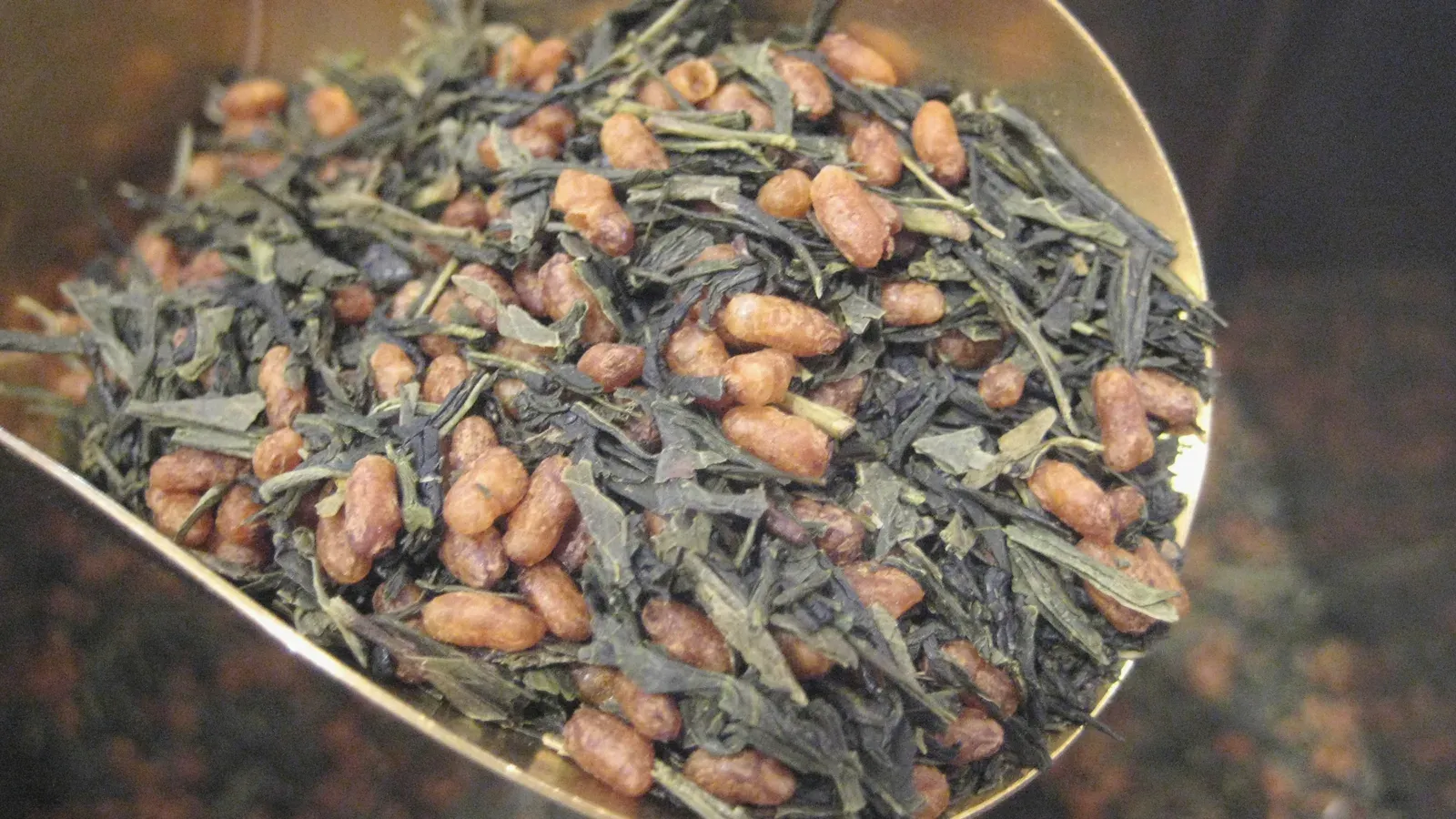
Genmaicha is green tea — usually bancha — blended roughly half and half with roasted rice. Despite a name that means “brown rice tea,” most of it is made with polished white rice, because brown rice scorches in the roaster. The rice displaces about half the leaf, which is why the cup runs near 10 mg of caffeine per 100 mL against sencha’s 20. Brew it at 90–100°C for 30 seconds.
Japan’s Standard Tables of Food Composition specify genmaicha (玄米茶) down to the percent. The reference blend is 50 percent sencha, 10 percent roasted glutinous rice, and 40 percent polished white rice that has been steamed, dried, and roasted 3. Read that list again. Half the bag is rice, and not one grain of it is genmai — brown rice — in a tea named after brown rice.
The name is the most interesting thing about this tea, and almost every English write-up repeats it without checking it.
What is in the bag
Half tea, half rice. The Global Japanese Tea Association puts the proportions at “usually half rice and half tea,” with bancha (番茶) as the normal base and high-grade sencha turning up occasionally 1. Yunomi calls the 1:1 ratio the standard 7. MEXT’s reference sample splits it 50/50 as well, though it uses sencha for the leaf half 3.
Leave that divergence standing. MEXT analyzed one standardized sample so its numbers would be reproducible, while the GJTA describes what the market sells. The composition table concedes the gap itself, in a clause most people quoting it skip: 配合のばらつきは大きい — the variation in the blend is large 3. Two bags labelled genmaicha can differ in leaf grade, rice type, and ratio, and both are correctly labelled.
The rice arrives at the roaster prepared. It is soaked in water overnight, drained, then roasted until it turns golden brown 7, and MEXT’s spec has the ordinary white rice steamed and dried first 3. Roasting starch is a different operation from roasting leaf, and if you want the chemistry of what heat does to tea itself, hōjicha is the tea built entirely on that question. Here the leaf goes in green. Only the grain sees the roaster.
Why white rice, in a tea named for brown
Brown rice keeps its bran layer, and bran burns. Chikiriya, a tea house trading in Kyoto since 1854, gives the reason plainly: the bran scorches easily under the roaster and the char follows the grain into the cup, while polished rice takes the heat without burning, finishes sweet and fragrant, and holds its aroma longer in the bag 8. So producers moved to white rice and kept the old word. Genmaicha is now the name of the tea rather than a description of it, and a blend made with either rice can be sold under it 8.
A tea named for an ingredient it mostly lacks sounds like a scandal. Call it a fossil instead, of the same kind as sencha meaning “simmered tea” for a leaf nobody simmers. Names outlive the practices that produced them.
The popcorn
Some grains burst in the roaster and puff into small white kernels, which is where the nickname “popcorn tea” comes from. Glutinous mochigome rice pops most readily, and MEXT’s spec accordingly separates it out as its own 10 percent of the blend, distinct from the 40 percent of ordinary polished rice 3. The GJTA notes the popping happens “sometimes by accident, sometimes on purpose” 1. Treat the white kernels as decoration with a faint aroma attached. They are not a grade marker, whatever the photography on the packet implies, and a bag that shows few of them may hold the better leaf.
Where it came from, honestly
Here is the story you will be told. A servant named Genmai dropped rice into his samurai master’s tea; the master beheaded him for it, tasted the tea, found it good, and named the blend in his honour.
There is no reason to believe any of it. The tale appears on Western tea retailers’ blogs and in no Japanese institutional source; several of the vendors who tell it concede in the same breath that it is likely invented. No servant, no master, no date, no document. I have cut it from this article except as an example of what to distrust.
The trouble is that the sober-sounding alternative is barely better attested. The usual replacement — thrifty households or merchants stretching expensive tea with cheap grain — is offered with dates ranging from the Muromachi period (1336–1573) through the Edo period, the 1920s, and on into wartime rationing in the 1940s. That is a spread of six hundred years. When the tellers of a story cannot agree on which century it happened in, they are reconstructing it backwards from the object. The tea looks like a thrift measure, so everyone infers it began as one, and the inference then gets retold as a memory.
Three things survive the scepticism.
The motive is attested by the industry body. The GJTA states that genmaicha “was created with the purpose of lowering the cost of tea and making the tea supply last longer” 2 — an institution describing the tea’s purpose, in its own words, on its own authority.
The period has a faint documentary trace. Several Kyoto firms are recorded selling the blend in the Taishō era (1912–1926) under trade names — hanayanagi (花やなぎ) and hōraicha (蓬莱茶) among them 9 — and Yunomi dates the same wave of Kyoto firms to the end of Taishō and the early Shōwa years 7. Multiple houses selling a thing at once under competing brand names is what a commercial product looks like. A single inventor with a good anecdote is what a legend looks like.
The specific origin is unknown. Chikiriya offers the Kyoto merchants who roasted the mochi left over from kagami-biraki, the New Year rice-cake breaking, and marks it as one theory 8. The Genmaicha Research Institute offers that one and a second from Zen temple cooking, the crisped rice scraped from the bottom of the pot, and cites nothing for either 10. Japanese Wikipedia’s own summary is 諸説ある: there are several theories 9.
The thrift is real even where the story isn’t, and it has a name: mottainai (勿体無い), the sense that something useful should not go to waste. That instinct runs through wabi-sabi and the tea room it furnishes, where a mended bowl outranks a flawless one. Genmaicha is the same instinct applied to the grocery bill.
The caffeine arithmetic
Rice contains no caffeine. Blend it into tea at 1:1 and every scoop holds half the leaf it otherwise would, so the cup carries about half the caffeine. The national figures bear that out.
| Tea (infusion) | MEXT reference brew | Caffeine / 100 mL | Tannin / 100 mL |
|---|---|---|---|
| Gyokuro | 10 g, 60°C, 60 mL, 2.5 min | 160 mg | 230 mg |
| Sencha | 10 g, 90°C, 430 mL, 1 min | 20 mg | 70 mg |
| Bancha | 15 g, 90°C, 650 mL, 30 s | 10 mg | 30 mg |
| Genmaicha | 15 g, 90°C, 650 mL, 30 s | 10 mg | 10 mg |
Figures from Japan’s Standard Tables of Food Composition, each tea on its own reference extraction 4; the methods are set out in the same tables 3.
Bancha and genmaicha share an identical reference brew, which makes them directly comparable, and the tannin column is where the blend shows its hand: 10 mg against bancha’s 30 and sencha’s 70. Genmaicha is the mildest thing in the green tea section of Japan’s own food tables. That is the low astringency the GJTA attributes to its low leaf content 1, quantified.
Now the caveat that most write-ups skip. The table reports caffeine as 0.01 g and 0.02 g per 100 g — one significant figure at this scale. A value printed as 0.01 could sit anywhere from 0.005 to 0.014. So the table can tell you that genmaicha belongs in the low band with bancha and sits clearly under sencha; it cannot support a claim that genmaicha has exactly half of anything. Any vendor quoting you genmaicha’s caffeine to the milligram is doing arithmetic, not measurement.
Two effects stack. The rice halves the leaf, and if the base is bancha, that leaf started lower — bancha is picked later and coarser than the tender early growth that goes into sencha. On that arithmetic a bancha-based genmaicha should be about the lowest-caffeine leaf tea most shops sell, short of a twig tea. Cool water is the other lever on caffeine, covered in matcha, caffeine and L-theanine, and it is one you cannot pull here — for the reason below.
How to brew it
Near-boiling water, thirty seconds. Three independent sources land in the same place.
| Source | Leaf | Water | Temp | Time |
|---|---|---|---|---|
| Ippodo 5 | 10 g (2 tbsp) | 240 mL | 100°C | 30 s |
| MEXT reference 3 | 15 g | 650 mL | 90°C | 30 s |
| GJTA 1 | — | — | 90°C or hotter | — |
Ippodo’s recipe scales cleanly: about 5 g to 180 mL for a single mug, water off the boil, thirty seconds, no stirring, and pour it out to the last drop so the next round starts clean 5. It gives a second steep and usually a third, each a touch shorter than you would expect, because the rice has nothing left to give after the first pour and the leaf empties fast at that temperature.
Genmaicha is close to unwreckable. Full numbers for every Japanese tea, and the reasons behind them, sit in the temperature and time guide.
Matcha-iri genmaicha
Some producers dust the blend with matcha powder. The GJTA describes matcha-iri genmaicha (抹茶入り玄米茶) as genmaicha with matcha added, which turns the liquor a brighter green and pushes a fresher taste through the toast 12. The powder washes off the leaf and hangs suspended in the cup, so you drink it whole instead of infusing it. That is where the colour comes from, and it is a real improvement if you find plain genmaicha’s toast one-note.
It also works against the main reason people choose this tea. You are adding whole powdered leaf back into a blend whose selling point is that it contains less leaf. One vendor’s estimate puts matcha-iri genmaicha near 35 mg of caffeine a cup against 30 for the plain version, but that number is arithmetic on assumed ratios with no measurement behind it, and I would not repeat it as a figure 11. The direction is sound and the size is unknown. If you are drinking genmaicha in the evening, buy it plain.
Is it still a humble tea?
The reputation is that genmaicha is what you drink when you cannot afford better. Ippodo, trading in Kyoto since 1717, files its genmaicha under bancha on the shelf and calls it an everyday tea that goes well with meals 6. So the humility is intact, and it is priced and shelved accordingly.
What has changed is that the good houses now make a serious version of it. Ippodo’s is branded gokujō (極上, “finest”), and it is built on yanagi (柳), the large plain leaves, with roasted rice 6.
Which brings me to the one thing I will argue about. Ippodo’s finest genmaicha is built on bancha, and a Kyoto house with three centuries of reputation to protect chose coarse leaf for its top blend on purpose. Read that as a judgment about what the rice does. Roasted grain is a loud, sweet, occupying aroma, and it lands directly on the delicate marine top notes that make a good sencha cost what it costs. The blend was designed to make ordinary leaf taste generous. Give it extraordinary leaf and it covers the very thing you paid extra for.
So: buy the bancha-based genmaicha and spend the difference on a separate bag of single-cultivar sencha you brew at 75°C and pay attention to. The premium sencha genmaicha and — worse — the gyokuro genmaicha that some shops now sell are category errors with a margin attached. Yunomi is straight about the norm here: the base is everyday leaf, and the high-grade sencha and kabusecha versions are the exception 7. They are the exception because they are the wrong idea, executed well.
All of which is an argument for buying the tea as what it is. Genmaicha earns its place among the rest of the Japanese leaf by being the cup you can hand to a child at nine in the evening, brew with water straight off a kettle nobody watched, forget for a minute, and still drink with pleasure. The others on that shelf each want something from you — a thermometer, a timer, your attention at sixty seconds. This one wants a kettle.
Half of it is rice. The rice is white. The name says brown, the servant never existed, and the century is a guess. Genmaicha survives all of that because the thing in the cup was engineered to be cheap and turned out to be unruinable, and in a hundred years nobody has found a reason to correct any of it.
Sources
11sourcesGlobal Japanese Tea Association, 'Genmaicha (玄米茶)'
SupportsName literally means 'brown rice tea'; rice usually mixed in is roasted white rice, sometimes glutinous (mochi) rice; proportions usually half rice and half tea; bancha usually the base, sometimes high-grade sencha; roasting pops some grains, sometimes by accident, sometimes on purpose; low tea-leaf content makes it low in astringency and caffeine; brew at 90°C or hotter to appreciate the buttery aroma; matcha iri genmaicha adds matcha for brighter colour and fresher taste
Global Japanese Tea Association, 'Japanese Tea Kinds'
SupportsGenmaicha is bancha (sometimes sencha) mixed with roasted rice; 'created with the purpose of lowering the cost of tea and making the tea supply last longer'; matcha iri genmaicha named as the matcha-dusted variant
MEXT, Standard Tables of Food Composition in Japan, ch. 3 §16 (し好飲料類)
SupportsGenmaicha composition: 'せん茶50%に煎ったもち米10%と蒸して乾燥後、焙煎したうるち精白米40%を混合したものであるが、配合のばらつきは大きい。' Reference extraction methods — genmaicha and bancha and hōjicha: 15 g of tea in 650 mL of 90°C water for 0.5 min; sencha: 10 g in 430 mL of 90°C water for 1 min; gyokuro: 10 g in 60 mL of 60°C water for 2.5 min
MEXT, Standard Tables of Food Composition in Japan, ch. 16 data tables (PDF)
SupportsCaffeine and tannin per 100 g of infusion: genmaicha (16041) caffeine 0.01 g, tannin 0.01 g; bancha (16039) 0.01 g / 0.03 g; sencha (16037) 0.02 g / 0.07 g; hōjicha (16040) 0.02 g / 0.04 g; gyokuro (16034) 0.16 g / 0.23 g. Values given to two decimal places, i.e. one significant figure at this scale
Ippodo Tea, 'Standard Genmaicha Brew'
SupportsStandard genmaicha brew: 10 g (2 tbsp) leaf, 240 mL water at 100°C, 30 seconds; brew without stirring or disturbing the leaves; pour out every last drop; boiling water used to bring out the full aroma
Ippodo Tea, 'Gokujo Genmaicha'
SupportsIppodo's top genmaicha (極上, 'finest') is built on yanagi — large plain green leaves — with roasted rice; categorised on the site under Bancha and described as 'one of the more popular banchas', good with meals and as an everyday tea
Yunomi, 'Genmaicha, the brown rice tea everybody loves'
SupportsA 1:1 ratio of toasted rice and bancha 'is generally regarded to be the standard'; rice soaked in water overnight, strained, then roasted golden brown; base is typically everyday rather than first-flush leaf, with exceptions using high-grade sencha or kabusecha; several Kyoto firms said to have begun selling the tea from the end of the Taishō era into early Shōwa (1920s)
Chikiriya (ちきりや, Kyoto, est. 1854), '「玄米茶」っていうのに玄米じゃないの?'
SupportsMost genmaicha is blended with roasted white rice; brown rice retains its bran, which scorches easily in roasting and shows up as burnt aroma and taste, whereas white rice roasts to a sweet, fragrant finish and holds its aroma longer; origin given as one theory — Kyoto tea merchants roasting mochi left from kagami-biraki; because 'genmaicha' is now an established term, either rice may be sold under the name
Wikipedia (Japanese), '玄米茶'
SupportsGreen tea and roasted rice in equal parts; bancha or occasionally sencha as base, mochigome common for the rice; several Kyoto tea firms recorded selling the blend in the Taishō era under trade names including 花やなぎ (hanayanagi) and 蓬莱茶 (hōraicha); article states 諸説ある (several theories exist) on the origin; many composition claims flagged 要出典 (citation needed)
Genmaicha Research Institute (日本玄米茶研究所), 'History of Genmaicha'
SupportsPresents two origin theories — pre-war Kyoto merchants roasting leftover mochitsuki rice crumbs, and Zen temple cuisine adding the crisped rice from the bottom of the pot to tea — with no names, dates, archives or documentary citations for either
Nio Teas, 'Matcha-iri Genmaicha Caffeine'
SupportsVendor estimate, arithmetic only and not a measurement: assumes 30 mg/cup for genmaicha, 34 mg/g for matcha powder and a 100:3 blend ratio to reach ~35 mg per cup for matcha-iri genmaicha; mechanism given is that the suspended powder is drunk rather than infused. No study or lab analysis cited
Image: Selena N. B. H. from Fayetteville, USA, Wikimedia Commons · CC BY 2.0
Common questions
Is genmaicha made with brown rice?
Usually not, despite the name. Genmai (玄米) means brown rice, but the Global Japanese Tea Association states that the rice blended into genmaicha is normally roasted white rice, sometimes glutinous mochi rice. Japan's national food composition table specifies its reference genmaicha as 40% roasted polished white rice and 10% roasted glutinous rice. The Kyoto tea house Chikiriya gives the reason: brown rice keeps its bran layer, which scorches in the roaster and carries a burnt taste into the cup. The name stuck anyway, and a blend made with either rice can be sold as genmaicha.
Does genmaicha have less caffeine than sencha?
Yes, roughly half. Japan's Standard Tables of Food Composition put a genmaicha infusion at 0.01 g of caffeine per 100 g against 0.02 g for sencha — about 10 mg per 100 mL against 20. The rice carries no caffeine, so blending it in at 1:1 halves the tea leaf in every scoop. If the base is bancha rather than sencha, the leaf was lower in caffeine before the rice was added. Note that the table rounds to one significant figure, so read these as bands rather than exact values.
Why is there popcorn in my genmaicha?
Those white kernels are rice that burst during roasting. Glutinous mochi rice puffs most readily, which is why it appears in the blend, and Japan's food composition table specifies 10% roasted glutinous rice alongside 40% ordinary polished rice. The GJTA notes the popping happens sometimes by accident and sometimes on purpose. The popped grains are largely cosmetic — they contribute a little aroma and lighten the look of the leaf.