The Leaf
Sencha: Japan's Everyday Green Tea
Sencha is over half of Japan's tea: steamed, rolled, brewed at 70–80°C. What it is, why rolled leaf brews fast, and how to choose a bag worth buying.
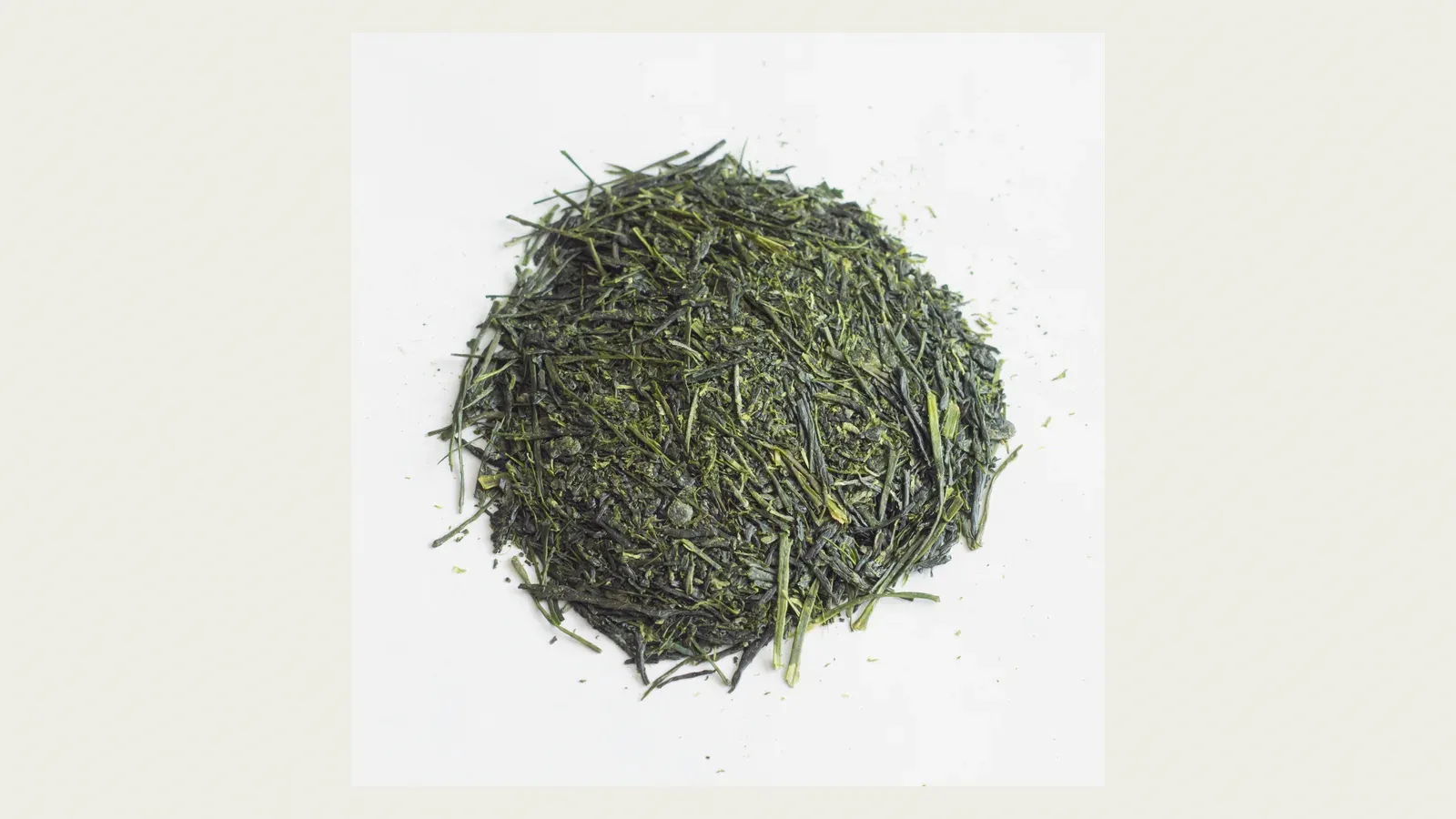
Sencha is Japan’s default green tea — grown in full sun, steamed within a day of picking, then rolled for hours into dark needles and dried. The Global Japanese Tea Association puts it at about 54% of national production. Brew it at 70–80°C for about 60 seconds, and re-steep it two or three times, each round hotter and shorter.
Sencha is younger than the tea ceremony Japan is famous for. In 1738, a tea maker named Nagatani Sōen — born 1681 in Yuyadani, in the hills of Ujitawara south of Kyoto — presented a processing method he had spent years working out on a hoiro, the paper-topped drying table heated from below 6. He steamed the young shoots, then rolled and dried them by hand at the same time, over and over, until the leaf came out green. It spread across the country. Nearly three centuries later, it is still what most Japanese tea is.
That word “most” carries more weight than it looks. Sencha (煎茶) accounts for roughly 54 percent of Japan’s total tea production 1. Figures move with the year and with what is being counted — some write-ups quote 80 percent, which appears to fold in the whole sun-grown family — so treat 54 percent as the sober number from the industry body, current as of 2026. Either way the shape holds. When someone in Japan says ocha, this is the cup they mean.
What sencha is
Three operations, in order: steam, roll, dry.
The first is the one that defines all Japanese green tea. Within a day of the pick, the leaf runs through steam, which deactivates the enzymes that would otherwise brown it. Steamed, not pan-fired — that is the fork that separates a Japanese green from a Chinese one, most of which is fixed in a hot pan or drum 2. Steam holds the marine, vegetal, faintly sweet register; firing toasts it toward nut and chestnut. The whole family tree is laid out at The Leaf, and every branch on it starts here.
Then the rolling, which is where sencha becomes sencha rather than any other steamed leaf. The steamed leaf is cooled and worked through several stages of kneading and rolling, for hours, until it twists into the tight dark needles you recognise in the bag. Finally it is dried, and most of the remaining moisture leaves 1.
Sun, steam, roll. Shade the same plant for three weeks first and you get gyokuro, which is otherwise processed identically. Pick the leaf late and coarse and you get bancha. Sencha is the baseline the rest of the shelf is measured against.
The tea Rikyū never drank
Sen no Rikyū was forced to commit seppuku in 1591. Nagatani Sōen’s method arrived in 1738 — 147 years later. The aesthetic of chadō, the Way of Tea, was fully formed before sencha existed, which is why chanoyu is built around whisked powder and has nothing to say about a teapot. Two Japanese tea cultures, a century and a half apart, and only one of them is what the country drinks at breakfast.
Before Sōen, ordinary loose leaf was rough work. Harvesting was unselective, processing wandered between steaming, boiling and pan-firing, and the result often came out brown rather than green 7. His contribution was consistency: young leaf, and rolling and drying carried out together over steady heat so the leaf dried evenly instead of scorching in patches.
The commercial half of the story is better than the technical half. Sōen took his tea to Edo, where the merchant Yamamoto Kahei bought it, renamed it tenka ichi (天下一, “first under heaven”), and made a fortune. By one account the house of Yamamotoya sent the Nagatani family an annual payment in thanks until 1874 7. Well over a century of royalties on a farming technique, paid by handshake and on no contract anyone has produced. The same merchant house turns up again in 1835 at the invention of gyokuro.
The name is a fossil. Sencha reads as “simmered” or “decocted” tea 2, a leftover from an older habit of boiling leaf that the tea itself abandoned long ago. Nobody simmers sencha now.
Why rolled leaf brews fast
Kneading ruptures the cell walls inside the leaf while the leaf itself stays whole, so when hot water arrives the contents are already exposed and flood out quickly 1. The needles are a side effect of that; the cell damage is the product.
This is why sencha brews in sixty seconds when a whole-leaf Chinese green might want three minutes, and it is also why sencha punishes you for looking away. A rolled leaf holds nothing back. Sixty seconds is a cup; three minutes is a mouthful of catechin. The mechanism that makes the tea convenient is the same one that makes it unforgiving.
Hand-rolling survives as a demonstration craft and a competition discipline. The industry mechanised early: Kenzo Takabayashi built the first rolling machine in 1896 1, and effectively all sencha has been machine-rolled since.
Steam depth: asamushi and fukamushi
One variable inside the steam step splits sencha into styles. Steam the leaf briefly and it stays intact — asamushi (浅蒸し), light-steamed, pouring a clear, pale, aromatic cup. Steam it longer and the leaf turns fragile and breaks into fragments, giving fukamushi (深蒸し), deep-steamed, which pours cloudy dark green, tastes rounder and thicker, and gives up its flavour faster still 10.
The exact boundaries are a mess, and any source that states them crisply is overselling. One producer guide puts asamushi at 20–30 seconds, chūmushi at 40–60, and fukamushi at 70–120 9; another puts the fukamushi line at anything over 40 seconds 10. There is no standards body drawing it. What is reliable is the direction of travel: more steam, more breakage, cloudier liquor, quicker extraction, less astringency, more body. Shizuoka’s Makinohara plateau is the heartland of the deep-steamed style, and Japan’s tea regions maps the rest.
If a bag says fukamushi, cut your steep time to 30–45 seconds and expect a cloudy cup.
Yabukita, and the taste of one tree
In 1908, a farmer named Sugiyama Hikosaburō picked two promising seedlings out of a field beside a bamboo thicket in what is now Suruga ward, Shizuoka. The one from the north side of the grove — yabu (thicket), kita (north) — became yabukita. It was registered as cultivar No. 6 in 1953, twelve years after Sugiyama died, and it went on to take over the country. Yabukita now covers roughly 75 percent of Japan’s tea acreage, and about 90 percent of Shizuoka’s 8. By 1972 it already held 88 percent of that prefecture’s fields 8. Those shares come via MAFF and NARO data and drift a few points depending on the year and the source, so read them as “about three quarters,” not as a decimal.
Here is my position. If you have tried sencha and found it fine but unremarkable, you have almost certainly only ever met yabukita. It is a superb all-rounder — balanced, aromatic, hardy across a wide range of climates, which is how it won the country — and a three-quarters monoculture means the “flavour of Japanese green tea” in most people’s heads is one 1908 seedling’s flavour.
So buy a single-cultivar sencha that isn’t yabukita, and drink the two side by side. Asatsuyu, registered in 1953 as cultivar No. 2, is nicknamed “natural gyokuro” because it arrives sweet and low in astringency with no shading at all 11. Saemidori — asatsuyu crossed with yabukita in 1969, registered as No. 40 in 1990 — buds four to seven days earlier and runs unusually low in astringency on a high amino-acid content 12. Okumidori buds late and pours a deep green, refreshing cup 13. None of them is better than yabukita. They are differently shaped, and an afternoon spent with two cups teaches more than a year of drinking the default.
Sellers who print the cultivar on the bag are a small minority, and they are the ones worth your money.
How to brew it
Two Kyoto producers and the industry body, all landing in the same place, which is a good sign the number is real.
| Source | Leaf | Water | Temp | Time |
|---|---|---|---|---|
| Ippodo 4 | 10 g (2 tbsp) | 210 mL | 80°C | 60 s |
| Marukyu Koyamaen 5 | 10 g | — | 75°C | 60 s |
| GJTA, warm brew 3 | 5 g | 80 mL | 60–70°C | 60–90 s |
For one mug, scale to about 5 grams per 180 mL and aim at 70–80°C. Copy Ippodo’s trick for hitting that temperature: pour the boiling water into another vessel once and it lands near 80°C 4. Then leave the pot alone — no stirring, no swirling — and pour out every last drop, because the strongest liquor pools at the bottom and left there it stews the next round 4.
Then re-steep. The GJTA reckons any Japanese tea gives at least three brews, with later rounds wanting more heat or more time to hold their strength 3. Marukyu Koyamaen splits the difference in the sharper way: second infusion a touch hotter, but only about 10 seconds, since a wetted leaf empties fast 5. Follow the second one. A 60-second second steep is how a good bag of sencha gets written off as harsh. Full numbers for every Japanese tea sit in the temperature and time guide.
How to buy it
Read four things and ignore everything else on the label.
Harvest date. Sencha is a fresh product and the aromatics fade in months, not years. A bag with no date is a bag someone is hoping you won’t ask about.
Region. Shizuoka, Kagoshima, Uji, Yame — a stated origin is a claim a seller can be held to.
Cultivar. See above. Its presence signals a seller who knows what is in the bag; its absence usually means yabukita or a blend.
Steam depth. Asamushi or fukamushi changes your steep time by half. It costs the seller nothing to print and tells you how to brew.
Grade words carry no weight here — there is no legal standard for tiers of sencha any more than there is for “ceremonial” matcha. If a bag gives you all four facts and a date inside the last six months, the tea is very likely good, whatever it costs. If it gives you an adjective and a mountain on the packaging, it is probably last year’s.
Nagatani Sōen spent years at that heated table to make a leaf that came out green instead of brown, and the merchant who bought it called it “first under heaven” and posted money back up the road to Ujitawara every year until 1874. The tea is still made the way he left it: steam, roll, dry. It is also still the tea you can wreck in ninety seconds with a kettle nobody let cool. Sencha survived by being ordinary, and it asks for one small courtesy in return — water at 75°C, which costs you a pour and thirty seconds of patience. Against a century of royalties, that seems a fair rate.
Sources
13sourcesGlobal Japanese Tea Association
SupportsSencha is ~54% of Japan's total tea production and the most-produced tea in the country; 1738 Nagatani Sōen of Uji invented the rolling method; rolling breaks the leaf cell walls while leaving the leaf intact, releasing flavour at brewing; drying as the final stage; Kenzo Takabayashi's first rolling machine in 1896
Global Japanese Tea Association
SupportsOxidation stopped by steaming rather than pan-frying as is common elsewhere; leaves rolled in stages after steaming and cooling; sencha the most consumed tea in Japan though only created in 1738; 'sencha' means 'simmered tea'
Global Japanese Tea Association
SupportsWarm brew 5 g / 80 mL / 60–70°C / 60–90 s, recommended for gyokuro, kabusecha and sencha; hot brew 5 g / 180 mL / 90–100°C / 20–30 s; cooler water reduces catechin and caffeine extraction with little effect on theanine; same leaves brew at least 3 times, raise temperature or lengthen steep on later rounds
Ippodo Tea
SupportsStandard sencha brew: 10 g (2 tbsp) leaf, 210 mL water at 80°C, 60 seconds; cool boiling water to 80°C by transferring once; brew undisturbed; pour out every last drop
Marukyu Koyamaen
SupportsSencha: 10 g leaf, water cooled to 75°C, 60 s first infusion; second infusion a little hotter for ~10 s; same leaves used up to three times
Ujitawara Town (Visit Ujitawara), 'The History of Japanese Green Tea'
SupportsNagatani Sōen born 27 March 1681, died 11 June 1778; steamed new shoots hand-rolled on a hoiro (rolling and drying table) without fermentation; 1738, when Sōen was 58, the Uji sencha processing method spread nationally; travelled to Edo and contracted with the tea merchant Yamamoto Kahei
My Japanese Green Tea, 'Nagatani Soen: The Inventor of Sencha'
SupportsBefore Sōen, loose leaf was poorly sorted and often brown rather than green, with inconsistent steaming/boiling/pan-firing; his method rolled and dried simultaneously over a furnace and selected young leaf; Yamamoto Kahei of Yamamotoya in Edo bought the tea, renamed it 'tenka ichi', and the firm sent annual payments to the Nagatani family until 1874
Tealife / Japanese Tea Pedia, 'Yabukita'
SupportsYabukita ~75% of national tea cultivation and ~90% in Shizuoka, citing MAFF and NARO data; selected by Sugiyama Hikosaburō in 1908 in what is now Suruga ward, Shizuoka city; registered 1953 as cultivar No. 6, after his death; 88% of Shizuoka's fields by 1972
Growing Karma, 'Asamushi, Chumushi, Fukamushi'
SupportsSteaming times: asamushi approx. 20–30 s, chumushi approx. 40–60 s, fukamushi approx. 70–120 s; longer steaming softens cell structures; fukamushi sencha pours cloudy
My Japanese Green Tea, 'About the Steaming Time of Sencha'
SupportsAlternative (shorter) boundaries — asamushi ~20–30 s, futsūmushi/chūmushi ~30–40 s, fukamushi greater than 40 s; longer steaming makes leaves fragile so fukamushi carries many broken fragments; asamushi pours clear and light, fukamushi deep green; deeper steaming raises pectin, lowering astringency and adding body
Shizuoka Tea, 'What is Asatsuyu Cultivar?'
SupportsAsatsuyu registered 1953 as Japanese tea cultivar No. 2; nicknamed 'natural gyokuro' because it tastes gyokuro-like without the shading process; retains amino acids, low astringency, balanced umami, bright liquor
Shizuoka Tea, 'What is Saemidori (さえみどり)?'
SupportsSaemidori = asatsuyu crossed with yabukita in 1969, fully registered 1990 as cultivar No. 40; astringency 'unusually low' from high amino acid content, deeply savory, sweet; early-budding, harvested 4–7 days before yabukita; name means 'clear green'
Osada Tea Japan, 'Japanese tea cultivars and their characteristics'
SupportsYabukita ~70% of Japan's tea plantations, created 1908, used as the benchmark cultivar; okumidori is late-blooming, good quality and not difficult to cultivate, gives a refreshing umami and deep green liquor, popular as a single cultivar or in a blend
Image: Difference engine, Wikimedia Commons · CC BY-SA 4.0
Common questions
Why is my sencha bitter?
Almost always the water was too hot. Catechins, the astringent compounds, extract far more readily as temperature climbs, while theanine — the sweet, savory amino acid — comes out at almost any temperature. Boiling water pulls the bitterness forward and buries the sweetness. Cool the water to 70–80°C by pouring it into a cup and back, and the same leaf turns round and sweet.
How many times can you re-steep sencha?
Two or three more times after the first. The Global Japanese Tea Association notes that Japanese teas will give at least three brews, and that later rounds want a higher temperature or a longer steep to keep their strength. Marukyu Koyamaen's method goes the other way on time: a second infusion a little hotter but only about 10 seconds, since the leaf is already wetted and gives everything up fast.
Is sencha the same as Chinese green tea?
Both are unoxidized green tea from Camellia sinensis, but the leaf is fixed differently. Japanese sencha is steamed, which halts oxidation and holds the fresh, marine, vegetal character. Most Chinese green tea is pan-fired, which toasts the leaf toward nut and chestnut. That single fork in processing accounts for most of the difference in the cup.