The Leaf
Single-Origin vs Blended Matcha: The Cultivars Behind Them
Most matcha is blended from several fields and cultivars for a steady house taste. Single-cultivar matcha shows one plant: Okumidori, Samidori or Asahi.
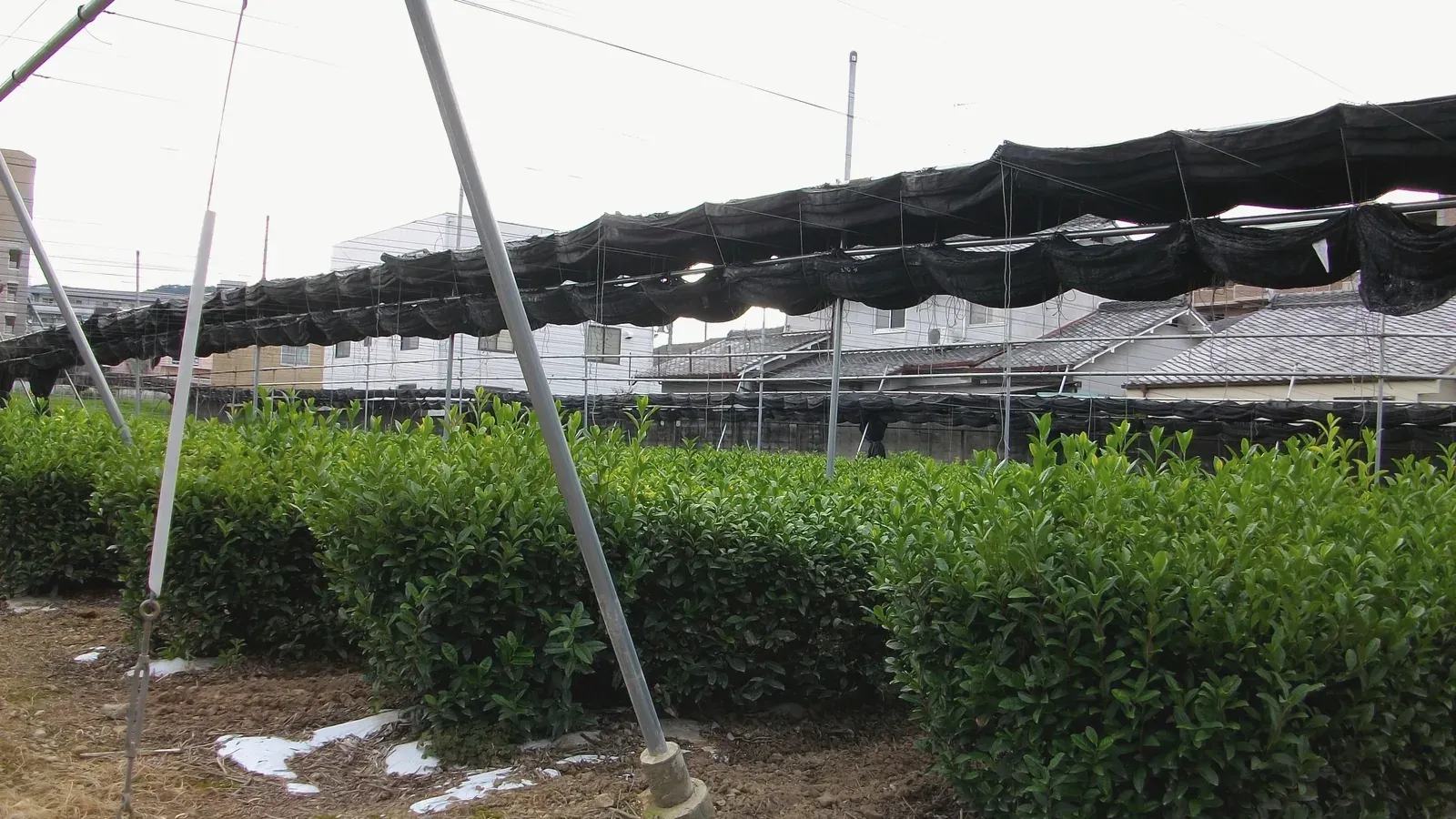
Most matcha is a blend: a tea merchant mixes tencha from several fields, often several cultivars, to hold one house flavour from year to year. Single-cultivar matcha, ground from one plant variety such as Okumidori, Samidori or Asahi, is the newer category. Buy it to learn what a cultivar tastes like. For a daily bowl, a good blend is usually the better tea.
Some matcha blends contain upwards of fifteen different tencha, by the count of the online Japanese-tea retailer Tezumi 1. Tencha (碾茶) is the shaded, steamed, flat-dried leaf that a stone mill turns into matcha, and Uji’s merchants have been combining lots of it since the early Edo period 2. Single-cultivar matcha, ground from one variety of tea plant, is the newcomer. Tezumi wrote in 2023 that it had caught on especially overseas 1.
Both make good tea. The label words that separate them are looser than they look.
Single-origin vs blended matcha at a glance
| Blended matcha | Single-cultivar or single-origin matcha | |
|---|---|---|
| What’s in the tin | Tencha from several fields, often several cultivars | One cultivar, one farm or one area, depending on the label |
| Who sets the taste | The house’s blender, the chashi (茶師) | The plant, the field and that year’s weather |
| Year to year | Held to a house standard | Shifts with each harvest |
| What the label names | The house and a tea name (chamei) | The cultivar, often the grower or prefecture |
| History | The norm in Uji since the Edo period | A newer category, most popular overseas (Tezumi, 2023) |
| Best use | Daily usucha, koicha, a tin you reorder | Learning a cultivar; side-by-side tasting |
What “single origin” means on a matcha tin
The phrase has no fixed meaning in matcha. Sellers use it for three different promises.
One region. The loosest, and in Tezumi’s phrase the minimum: “a geographic location, say Uji or Yame” 1. “Uji tea” has a written definition, adopted by the Kyoto Prefecture Tea Industry Association in 2004: tea grown in Kyoto, Nara, Shiga or Mie and finished inside Kyoto by a Kyoto firm, with Kyoto leaf given priority 5. A tin of Uji matcha can draw on four prefectures and still be correctly labelled. The same caution runs through all of Japan’s tea regions.
One farm or producer. Tezumi adds that “in common usage it also implies that the tea comes from a single farmer/producer,” and that is how it uses the term 1. One farm can still grow, and mix, several cultivars.
One cultivar. “Single cultivar means that the tea is only made from one cultivar of the tea plant,” in Tezumi’s wording 1. That names the plant. Unless the label adds a grower, a merchant can combine Okumidori from three farms into one tin and call it single-cultivar with a straight face.
The strongest claim is all three at once: one cultivar, one named grower, one harvest year. When a tin says only “single origin,” ask which of the three it means. A seller who knows will answer in a sentence.
Why matcha has always been blended
Blending has its own word in Japanese tea, gōgumi (合組), and its own trade, the chashi, whom GJTA calls professional tea blending masters 3. The platform promoting Uji’s tea landscape for World Heritage listing records that in the early Edo period Uji’s chashi blended by gōgumi to suit the taste of tea people in Kyoto and beyond. Until the late nineteenth century, growing tea for matcha in Uji was reserved to those same chashi 2.
The reasons have held steady. Tea is a farm crop, and the Global Japanese Tea Association points out that “it is essentially impossible to obtain the exact same tea with a 100% identical taste and aroma profile year after year.” GJTA is candid that consistency is only one motive: blending can also “control costs, raise a tea’s market value, or ensure an adequate supply of leaf material when there is a shortage.” Its summary is plain: “the majority of Japanese tea is still blended. Matcha is a striking example of this” 3.
Ippodo, the Kyoto house, set out its own method in April 2026. Its matcha is “produced by blending tea from multiple tea fields, rather than just one,” for complex flavour and stable quality, and the firm places “the most importance on the taste” ahead of fragrance and colour. It also concedes that the strength of the seaweed-like aroma that shading gives its leaf “varies to some degree from one production lot to another,” and that it works to keep the overall fragrance “within a certain range” 4. That second sentence is the chashi’s job description.
Kyoto’s wholesalers still work this way. They buy crude leaf, aracha (荒茶), from growers, sort it and blend it to their customers’ taste 5, and they trade with one another when a blend needs leaf of a particular character 6.
Chamei: the name instead of the recipe
A finished blend is sold under a poetic name, and the components almost never appear on the tin. Tezumi calls disclosure “incredibly rare” 1. The name is the chamei (茶銘). Some are o-konomi (御好), blends named as the preference of an iemoto, the hereditary head of a tea school. Yamamasa Koyamaen’s catalogue shows the pattern: for Urasenke’s grandmaster Zabōsai it lists Senri no mukashi (千里の昔) and Yūwa no shiro (悠和の白), with matching pairs for Omotesenke and Mushakōjisenke 7. By a loose convention, a mukashi name often, though not always, marks a thick-tea grade and a shiro name a thin-tea one, as usucha vs. koicha explains.
The named matcha of the three Sen schools is, in the usual case, a merchant’s blend carrying a grandmaster’s preference. Tezumi grants that single-origin tins may be very good and still “simply not of the style preferred by most tea ceremony practitioners” 1.
The cultivars behind the bowl
One plant dominates Japan’s tea fields. Kyoto’s tea research institute, on a page last updated in 2022, puts yabukita (やぶきた) at about 68 percent of the country’s cultivated area 8. Even in Kyoto it holds 802.9 of the 1,411.8 hectares that the prefecture’s 2023 survey breaks down by cultivar, about 57 percent 9. Kyoto’s own breeding pulled the other way: nearly every green-tea cultivar bred in the prefecture is for shaded tea, tencha and gyokuro (玉露) 8.
| Cultivar | Bred by, from | Year bred or named | What the breeders and growers’ bodies say | Kyoto area, 2023 |
|---|---|---|---|---|
| Samidori (さみどり) | Koyama Masajirō, selected from Uji seedling bushes | 1954 | Tencha with a vivid, clear colour and fine aroma and flavour; upright bush, easy to hand-pick | 133.4 ha |
| Asahi (あさひ) | Hirano Jinnojō, selected from Uji seedling bushes | 1954 | ”Particularly excellent” as tencha; much used for competition tea | 23.2 ha |
| Uji-hikari (うじひかり) | Kyoto Tea Research Institute | 1954 | Soft, even tencha, bright in colour | 22.1 ha |
| Okumidori (おくみどり) | National tea research station, yabukita × Shizuoka native No. 16 | 1974 | Late; dark green, fresh and clean; “no faults or quirks” | 173.9 ha |
| Saemidori (さえみどり) | National station at Makurazaki, yabukita × asatsuyu | 1990 | Early; colour and taste above yabukita; takes shading well | 16.3 ha |
| Seimei (せいめい) | NARO at Makurazaki, fūshun × Saemidori | 2020 | Suited to tencha for matcha, NARO says | not listed |
For the Uji selections the year is the institute’s breeding year. For the national cultivars it is the year of naming or registration. Years and descriptions are from the Kyoto institute 8, the breeding report 10, the World Green Tea Association 11 and NARO 12. The hectares cover all tea types in Kyoto Prefecture, not tencha alone 9.
Samidori, Asahi and Uji-hikari: the Uji selections
Kyoto grows these three as its main tencha cultivars, hand-picked under intensive care 8. Samidori’s new buds are pale green, glossy and fresh, and its tencha has a clear, bright colour with excellent aroma and flavour. Asahi is “particularly excellent” as tencha and turns up again and again in competition entries. Uji-hikari makes soft, uniform tencha that takes its colour well 8.
Two of the three rest on very little ground. The whole prefecture grew 23.2 hectares of Asahi and 22.1 of Uji-hikari in 2023, each less than a fifth of its Samidori 9.
Okumidori: the national cultivar that took root in Kyoto
Okumidori came from the national tea station in Shizuoka, a 1953 cross of yabukita with a Shizuoka native selection, registered as Tea Norin No. 32 in June 1974 10. It buds about eleven days after yabukita and is picked about eight days later, which lets a farm that grows both spread its harvest 11. The World Green Tea Association’s cultivar note is unusually frank. In our translation: “Its quality is not especially distinctive, but it has no faults or quirks, and it is an easy cultivar to use” 11. The same note records that Aichi rates it highly as tencha, and that Kyoto’s sencha districts use exactly that pairing with yabukita. Kyoto now has 173.9 hectares of it, more than any cultivar but yabukita, across all tea types 9.
Saemidori and Seimei: from the south
Both come from the national station at Makurazaki in Kagoshima. Saemidori, yabukita crossed with asatsuyu, was named Tea Norin No. 40 in June 1990 10. NARO rates its colour and taste above yabukita’s and notes it takes shading well, though its handbook lists it for gyokuro and kabusecha rather than tencha 12. Its life as an early sencha is in the sencha guide, one of the seven Japanese green teas.
Seimei is the only cultivar here whose breeders name matcha outright. Registered in March 2020, it is suited, NARO says, to making tencha “as raw material for matcha and powdered tea, for which demand has risen sharply at home and abroad” 12.
What a single-cultivar tin is for
Single-cultivar matcha is the best way to learn what a cultivar tastes like, and a blend is usually the better bowl.
The cultivar notes above describe leanings: Samidori’s bright colour, Asahi’s standing in competition, Okumidori’s clean, faultless middle. A chashi combines those leanings so no single one tips the bowl, then does it again the next year when the weather has moved every component 3. A single-cultivar tin gives up that correction on purpose. Tezumi, whose own range includes single-origin teas, states the cost plainly: “Quality and flavour can be inconsistent between years.” It still calls the named blend “the standard for matcha, both in and out of the tearoom” 1.
That missing correction is the single tin’s use. Take two cultivars from one producer, same harvest year, same grade, whisked the same way, and the plant becomes the main variable left. Side by side, the table above turns into something you can taste.
How to choose
- For daily usucha: a blend from a named house, reordered. Consistency is what the chashi is paid for. Grade, freshness and milling matter more than origin, and they are set out in ceremonial vs. culinary matcha.
- For koicha: a blend again, ideally a house’s thick-tea grade.
- To learn cultivars: two single-cultivar tins from the same producer and harvest year. Okumidori against Samidori is a sensible first pair: a national all-rounder beside an Uji selection.
- On any “single origin” tin: look for the cultivar, the grower or prefecture, and the harvest year. A tin that names none of the three is selling the phrase. The rest of the vocabulary is in reading a tea label.
- Watch for tea names that sound like cultivars. Yamamasa Koyamaen lists a matcha called Samidori among its house tea names, beside poetic ones such as Matsukaze (松風), and its catalogue says nothing of cultivar 7. On the front of a tin, a cultivar’s name may be a chamei. Look for the words “single cultivar.”
Asahi and Samidori came out of Uji’s seedling bushes in 1954, inside a trade where the chashi decides what reaches the bowl. Tasting one of them alone is the recent liberty, and the quickest way to learn what a chashi has to work with.
Sources
12sourcesTezumi, 'Single Origin vs Blends: Comparing Two Different Styles of Tea Production' (2023-09-15)
Supports'Some matcha blends can have upwards of fifteen different tencha as ingredients.' 'Quite simply, single origin means that a tea comes from one location. At minimum, this is a geographic location, say Uji or Yame, but in common usage it also implies that the tea comes from a single farmer/producer which is how we use the term here at Tezumi'. Each matcha blend 'is given a poetic name by the tea producer'; of single-origin teas, 'they are simply not of the style preferred by most tea ceremony practitioners'. 'Single cultivar means that the tea is only made from one cultivar of the tea plant.' 'Even as single origin and single cultivar matcha have become increasingly popular, especially overseas, this named and blended style is the standard for matcha, both in and out of the tearoom.' Ingredients of blends are 'incredibly rare' to see disclosed. Single origin: 'Quality and flavour can be inconsistent between years'
Uji Tea World Heritage Promotion Platform (宇治茶世界文化遺産登録推進プラットフォーム), 「宇治茶の歴史と発展」
SupportsEarly Edo (1603–1691): 「宇治茶師は、合組とよばれるブレンドを行うなどの創意工夫を凝らし、京都をはじめとする茶人の好みに合わせた茶をつくる」; 「抹茶」の栽培は19世紀後期までは宇治茶師のみにしか認められていなかった
Global Japanese Tea Association, 'Tea Blending in Japan' (2024-09-27)
SupportsGōgumi (合組) means blending; done by masters called chashi (茶師). 'it is essentially impossible to obtain the exact same tea with a 100% identical taste and aroma profile year after year'; blending may also 'control costs, raise a tea's market value, or ensure an adequate supply of leaf material when there is a shortage'; 'While there is a growing interest in single cultivars, the reality is that the majority of Japanese tea is still blended'
Ippodo Tea (Global), 'The Flavour of Ippodo Matcha' (2026-04-01)
Supports'Ippodo matcha is produced by blending tea from multiple tea fields, rather than just one. This is done with the aim of producing complex flavour and maintaining stable taste and quality.' 'we place the most importance on the taste.' Shade-grown fragrance 'varies to some degree from one production lot to another'; 'we work to keep the overall fragrance within a certain range'
Kyoto Prefecture Tea Industry Association (京都府茶業会議所), 「宇治茶Q&A」
SupportsDefinition adopted 2004 (平成16年): Uji tea is tea grown in Kyoto, Nara, Shiga and Mie 「京都府内業者が府内で仕上げ加工したもの。ただし、京都府内産を優先する」. Wholesalers buy 荒茶 (aracha), sort it, and do 「合組」, blending different finished teas 「お客様の好みに合わせたお茶に仕上げています」
Kyoto Prefecture Tea Industry Association (京都府茶業会議所), 「茶取引」
SupportsKyoto tea merchants trade among themselves 「合組原料として希望する茶筋が欲しい場合」, i.e. when they want a particular character of tea as blending stock
Yamamasa Koyamaen (山政小山園), 「抹茶(茶道用・飲用)」 product catalogue
SupportsLists 御家元御好茶銘: for Urasenke 坐忘斎家元御好 千里の昔 and 悠和の白; parallel 昔/白 pairs for Omotesenke and Mushakōjisenke. House tea names (山政小山園茶銘) include さみどり and 松風 (Matsukaze)
Kyoto Prefectural Tea Research Institute (京都府茶業研究所), 「宇治品種について」 (updated 2022-08-30)
SupportsMost Kyoto-bred green-tea cultivars are for shaded tea (tencha, gyokuro); yabukita about 68% of Japan's cultivated area. Asahi: Uji native selection 平野11号, Hirano Jinnojō, 1954, 「てん茶として特に優秀、出品茶用として多用される」. Samidori: 小山69号, Koyama Masajirō, 1954, very upright and easy to hand-pick, buds pale green and glossy, 「色沢に冴えがあり、香味に優れる」. Uji-hikari: 京研170号, 1954, tencha soft and even, bright, 「染まりがよい」. 'あさひ、さみどり、うじひかり' are the main tencha cultivars, hand-picked under intensive management. Gokō: 1954, bred for gyokuro
Kyoto Prefecture, 「令和5年度 京都府産茶の生産・流通状況等に関する資料」 (table キ, 優良品種別栽培面積)
SupportsPrefecture totals, named-cultivar area in ha: yabukita 802.9, Okumidori 173.9, Samidori 133.4, Gokō 63.4, Asahi 23.2, Uji-hikari 22.1, Saemidori 16.3; total 1,411.8. Covers all tea types, not tencha alone
Breeding Research (育種学研究) 8(3), 2006, Takeda Yoshiyuki et al., 「緑茶用早生品種『さえみどり』および晩生品種『おくみどり』の育成」
SupportsOkumidori: bred at the national tea research station (now NARO, Kanaya) from yabukita (♀) × Shizuoka native No. 16 (♂), crossed 1953, selected for late harvest and sencha quality; 「1974年6月に茶農林32号、『おくみどり』として命名登録」. Saemidori: yabukita × asatsuyu, crossed 1969 at the Makurazaki branch; 「1990年6月に茶農林40号」; registered under the Seeds and Seedlings Act November 1991 (No. 2881)
World Green Tea Association, O-CHA NET, 「おくみどり ─ 『やぶきた』と組み合わせて摘採期を拡大する ─」 (reprinted from the monthly 『茶』, Shizuoka Tea Chamber)
SupportsBuds 11 days and is picked 8 days later than yabukita; dark green, 「香味はさわやかですっきりしていて良好」; 「特に個性的な品質ではありませんが、欠点やくせがなく、使いやすい品種です」; Kyoto sencha districts pair mid-season yabukita with late Okumidori to spread the harvest; 「愛知県ではてん茶として…高く評価されています」
NARO (農研機構), 『茶品種ハンドブック』 6th ed., version 2 (August 2022)
SupportsSaemidori: やぶきた × あさつゆ, NARO Makurazaki; colour and taste better than yabukita; 「被覆適性があり、玉露、かぶせ茶に向いている」. Seimei: ふうしゅん × さえみどり, bred at NARO Makurazaki, registered March 2020; suited to tencha, gyokuro, kabusecha; 「近年国内外で需要が急増している抹茶・粉末茶の原料としてのてん茶・もが茶の製造に適する」
Common questions
Is single-cultivar matcha better than blended matcha?
Not as a rule. Blending is the traditional way to make matcha, and the Global Japanese Tea Association says most Japanese tea is still blended. A single-cultivar tin gives up year-to-year consistency in exchange for a clear view of one plant. Judge either kind by grade, producer and harvest date before origin.
Which cultivar is best for matcha?
There is no single best. Kyoto's tea research institute names Samidori, Asahi and Uji-hikari as the prefecture's main tencha cultivars, all dated to 1954. Okumidori, a 1974 national cultivar, now covers more of Kyoto's tea fields than any cultivar except yabukita. Asahi and Uji-hikari are the rare ones: 23.2 and 22.1 hectares in the whole prefecture in 2023.
What does Okumidori matcha taste like?
A cultivar note published by Japan's World Green Tea Association describes Okumidori tea as dark green with a fresh, clean flavour, and calls it a cultivar without faults or quirks rather than a strongly individual one. It does not describe Okumidori matcha specifically. A vendor's tasting note for a particular tin will vary with the farm and the harvest.