The Implements
Kensui, Hishaku & Futaoki: The Overlooked Three
The waste-water vessel, the bamboo ladle and the lid rest: why they arrive in one hand, how the ladle and lid rest change with the season, and what to buy.
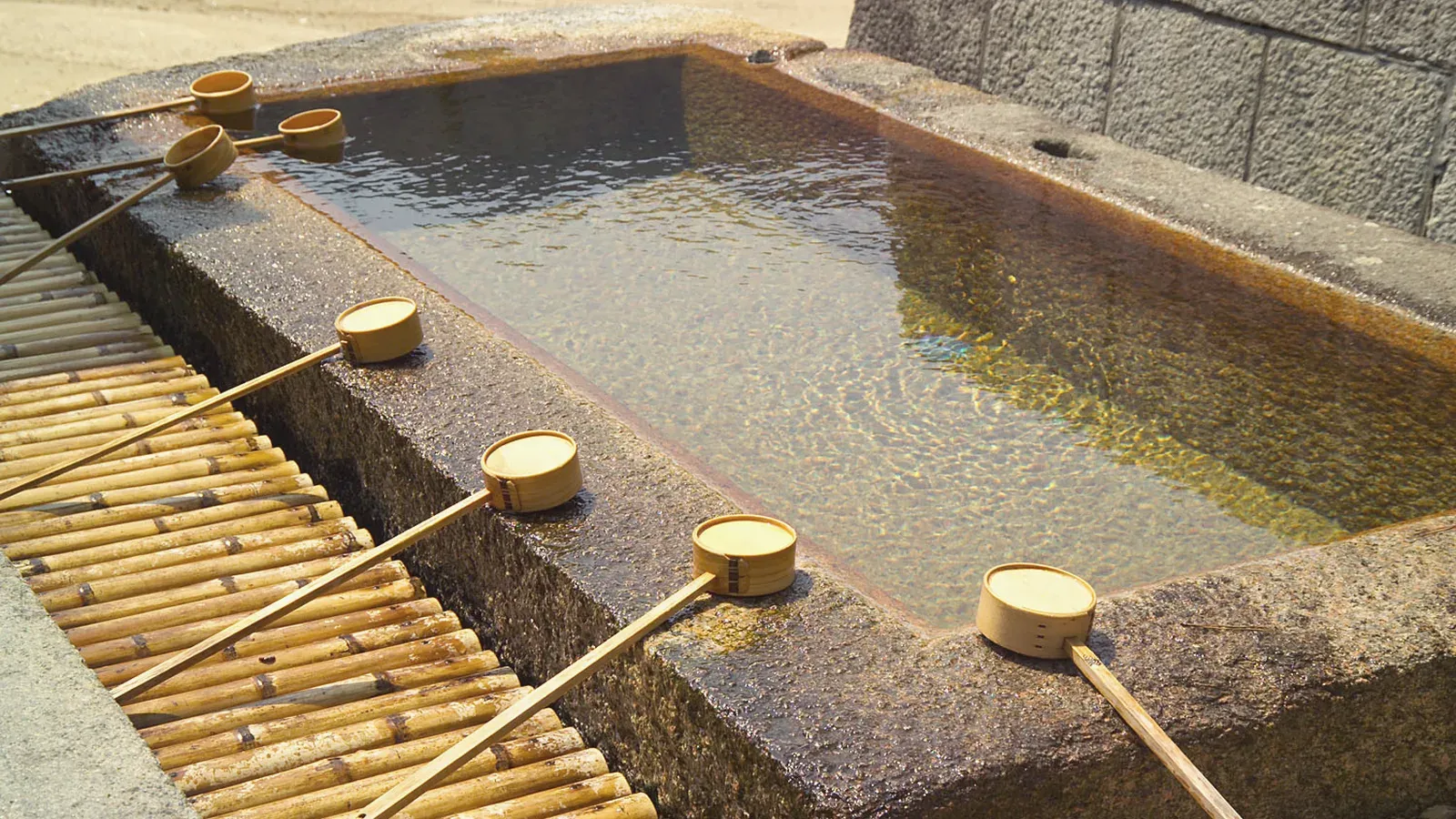
The kensui, hishaku and futaoki come into the tea room in one hand: the waste-water vessel held at the host’s left, the lid rest sitting inside it, the bamboo ladle hooked across its mouth. They are the last things carried in and the first carried out. The kensui is the lowest-ranked utensil in chanoyu, written at the tail of a gathering’s record on a line set below the others.
Every tea gathering leaves a paper record of what was used, the kaiki (会記). The bowl is on it. The scroll, the kettle, the caddy, the scoop, the flowers and the container they stood in are all on it, in an order that reflects what each one is worth. At the bottom, on a line set a step below the rest, is the kensui. 8 The vessel that catches the rinse water is written down, and it is written down last, and the indent is part of the notation.
The utensil glossary names these three in a single paragraph and moves on, which is the correct proportion for a glossary and the reason they have no article. Individually they are thin. Together they are the crew that serves the other utensils, and they have something in common that no list makes obvious: they arrive as one object.
The three arrive in one hand
Watch the host come in. Everything else has been set already: the mizusashi standing in place, the kama in the fire, the bowl and caddy carried in. The last entrance is the kensui, held by its mouth in the left hand, the futaoki inside it, the hishaku hooked over its rim. 6 The host sits, takes the ladle into the left hand, reaches into the waste-water vessel with the right, lifts out the lid rest, and sets it in its place. 6 When the utensils go out, the kensui goes first, in the same hand it came in. 6
So the three of them make one trip in and one trip out, and the other nine or ten objects on the mat get carried like guests.
An old gloss explains why. On the daisu (台子), the formal display stand, the matched set called kaigu (皆具) runs to four pieces: the water jar, the shakutate (杓立) that the ladle stands upright in, the kensui, and the futaoki. 23 Yamashina Dōan, the physician who wrote down the tea of the regent Konoe Iehiro between 1724 and 1735, noticed the gap in that arrangement: the ladle has its stand and the whisk has its own rest, and the futaoki alone has nowhere to be displayed. 11 With everything else already set out, the only object left for the host to carry is the koboshi. So the lid rest rides in inside the waste-water vessel, out of sight, and the word for that is kakurega (隠架), the hidden dwelling. 11 25
The most formal arrangement in chanoyu produced a name for a utensil hiding in a bucket.
Kensui: the vessel at the bottom of the list
Also called koboshi (零し), “the spill.” 1 It catches the water that has warmed the bowl and rinsed the chasen, and it does nothing else.
The references are blunt about its position and offer no philosophy with it. Lowest in rank of all the utensils; used at the kattetsuke (勝手付), the side of the host’s mat away from the guests, where it can barely be seen; entered last in the kaiki, one step down. 8 21 JAANUS supplies the working half of that: emptying waste water is an unclean job, a clean kensui is used for every gathering, and reusing one in front of guests is a discourtesy. 1 Everything else in the room is presented, turned, and looked at. This one is worked around.
It is small. The Met’s Takatori-ware kensui, iron-glazed stoneware from the middle of the nineteenth century, stands 9.5 cm high and 14.6 cm across — a cereal bowl. 4 Metal, ceramic and bent wood are all standard, and the bowl shape is the commonest. 1
The seven forms, and where their names come from
There is a classical set of seven, and reading them as a list tells you who was in the room when they were named.
| Form | Kanji | What the name means |
|---|---|---|
| ō-wakizashi | 大脇差 | a samurai’s long short-sword, worn at the waist |
| sashikae | 差替 | a smaller ō-wakizashi 17 |
| bō-no-saki | 棒の先 | the metal ferrule on the tip of a palanquin pole |
| yari-no-saya | 槍の鞘 | a spear scabbard: a cylinder opening out at the top 17 |
| efugo | 餌畚 | a falconer’s feed basket — small mouth, flaring rim 1 |
| kanadarai | 鉄盥 | a metal washbasin; shallow and low 17 |
| tanpyō | 箪瓢 | a gourd, pinched at the waist 8 |
Swords, a spear scabbard, a palanquin fitting, a hawking bag. The utensil at the bottom of the record takes its names from the kit of men who came to tea with two blades in their belts, and nobody along the way appears to have thought this needed remarking on. (The sources disagree on the seventh: some write 箪瓢, some 瓢箪. 8 17)
The plainest form has the best story. A mentsū (面桶) is a bentwood tub. Takeno Jōō (1502–1555) used one, and the Edo anecdote collection Chanoyu Kojidan says he took the idea from the rice container a pilgrim carries at the waist. 9 It stayed in the preparation room until Rikyū brought it onto the mat, and bare, unlacquered wood is still its formal version. 8 So at the most rigorous end of chanoyu, the rinse water goes into a beggar’s lunch box.
Hishaku: one node of bamboo, cut for the season
The kama has no spout. Water leaves it a ladleful at a time, which makes the hishaku the only means of moving hot water in the room, and the ladle is a stick of bamboo.
Its parts are named down to the last millimetre. JAANUS lists eight, among them the ridge on the cup’s lip (shinogi 鎬), the joint where handle meets cup (kerakubi 螻首), the profile of the handle above and below the node (kijimata 雉子股), and the cut at the handle’s end (kiridome 切止). 2 A ladle for the sunken hearth runs about 40 cm long. 2
Making one is slower than the object suggests. Mihara Keiji, who cuts hishaku for a living, takes green bamboo, stands it a month or two to lose its water, boils the oil out, dries it in the sun, then lets it sleep for one to three years before he touches it. 15 The cup is joined to the handle without adhesive, and he cuts to order, for each gathering. 15 Over a hundred variants are said to have existed, made to individual tea masters’ preferences and to the mouths of particular kettles. 22
Telling a ro ladle from a furo ladle
The same ladle is not used all year. Two are, and three things separate them.
| furo ladle (May–October) | ro ladle (November–April) | |
|---|---|---|
| Cup | smaller 16 | larger — the sunken hearth takes a larger kettle 2 |
| Kiridome | the bevel takes off the flesh, the pale inside 15 | the bevel takes off the skin, the hard green outside 15 |
| Hane (the angle where handle meets cup) | low 16 | high 16 |
The kiridome is the one students learn by rhyme: mi ga sogete iru no ga natsu — the shaved flesh means summer. 16 A ladle cut square across the end, with no bevel either way, is made to serve both seasons. 2
A third build exists and it is the oldest. The sashitōshi (差通し) runs its handle all the way through the cup and out the far side, and it is what stands in the shakutate on the daisu or the long board, which is why it is also called kazari-bishaku (飾柄杓), the display ladle. 22
Why the tea year runs two hearths at all, and what changes in November, is furo versus ro. Down here, that whole argument comes to a bevel on the end of a stick.
Futaoki: the hidden dwelling
Five centimetres tall, and it holds the two things in the room that are too hot to set on a mat: the kama’s lid, and the cup end of the ladle. 3 The fukusa comes off the host’s waist to lift that lid, because bronze at 90°C carries no insulation. The lid still has to go somewhere afterwards.
The Met’s iron example, from the eighteenth century, stands 5.1 cm high and 7 cm wide. 5
The seven futaoki
Bronze, ceramic, and porcelain, and they are the ones people collect. Urasenke’s own account traces them back to the bronze futaoki of the daisu kaigu, which broke free of the set and multiplied. 14 Students learn them by a mnemonic line: kani, gotoku, hoya, ikkanjin, mitsu-ningyō, mitsuba, sazae — call these seven the seven. 24
| Futaoki | Kanji | What it is |
|---|---|---|
| hoya | 火舎 | a small lidded incense burner, seen as a lid rest; highest ranked of the seven 12 |
| gotoku | 五徳 | a miniature of the iron trivet, three claws on a ring 11 |
| ikkanjin | 一閑人 | a well-curb with a small figure leaning over to peer in |
| mitsu-ningyō | 三人形 | three Chinese children holding hands in a ring |
| kani | 蟹 | a crab |
| sazae | 栄螺 | a turban shell 26 |
| mitsuba | 三葉 | a large leaf and a small one, stacked |
Two of them are better than their pictures. The gotoku copies the iron trivet that holds the kettle in the hearth, and you use it in exactly the months when the hearth has no trivet in it: with a kettle hung from a chain, or a brazier cast in one piece with its kettle. 11 The missing trivet is answered by a five-centimetre bronze trivet with a lid on it. The kani started as stationery — bronze crabs of this kind were paperweights and brush rests, borrowed onto the mat. 13 The sources send it further back, to a bronze crab from Ashikaga Yoshimasa’s garden at the Jishō-ji picked up by Jōō, and they mark that as handed-down story with no record behind it. 13
Then there is the question of whether Rikyū chose the seven, since everyone asserts he did and the careful references say said to have been chosen. 7 10 The oldest list anyone quotes, from the Chanoyu Kojidan, opens “what they call in recent times the seven lid rests” and then names mitsuba, kani, sazae, hoya incense burner, three monks, gotoku — and wa, a ring, where the modern list has the ikkanjin. 10 Six stable, one swapped, and an attribution that arrives already hedged.
The bamboo one
A bamboo futaoki is called hikikiri (引切), meaning cut with a saw and left at that. 14 Rikyū’s size is 1 sun 8 bu, about 5.5 cm tall, for both seasons. The ro piece is taken from nearer the root and the furo piece from the next node up, so the wall thickness comes out about the same. 20 The ro one is roughly 5.5 cm across and the furo one 4.8. 20 It is cut upside down, root end up, and a small vent hole is bored through the node. 7 9
The season rule is the same one the ladle runs, in a different alphabet:
| furo (May–October) | ro (November–April) | |
|---|---|---|
| Name | tenbushi 天節 | nakabushi 中節 |
| Node | at the top edge 3 7 | at or a little above the middle 3 14 |
That rule has a story attached, and the story is late. The Chadō Sentei, an Omotesenke-line compendium put together by Inagaki Kyūsō (1770–1819) and printed in 1847 19, says the bamboo lid rest began with Jōō at 1 sun 3 bu, a preparation-room object. Rikyū enlarged it to 1 sun 8 bu, cut one with the node in the middle and one with the node at the top, and sent them to his two sons — the top-node one to Shōan, the middle-node one taken by Dōan. From that, the text says, it came into the room, and from that the seasons were fixed. 9 The Chadō Sentei is two and a half centuries downstream of Rikyū. Take the sons as tradition and the measurements as practice.
The finish is prescribed to the stroke. The Chafu (茶譜) instructs: saw it with a fine-toothed blade so the skin does not tear, leave the saw marks, bore the hole in the node — and a hole that comes out roundly beautiful is rejected as nurui, tepid. 9 A rule against tidying the cut, and a term of abuse for a hole that turned out too nice. Anyone looking for what wabi-sabi means in a physical object could stop here and be finished.
What they are worth
Buy the bowl and the whisk. None of these three works in a kitchen: they all exist to serve a kettle that cannot pour, and your kettle pours.
If you buy one thing, buy a pair of bamboo futaoki, tenbushi and nakabushi, for the price of a coffee. Here is the position I will defend. Do not buy the crab. The seven are shelf utensils, used in tana temae, with a place laid for them on the stand. 24 7 In a koma, the small room — the room wabi-cha was invented in and the room the whole argument leads to — the lid rest is bamboo and nothing else. 20 A bronze crab is a lovely object that the tradition’s central room will not admit, and the honest way to want one is to want it as what it was before it was a lid rest, which is a paperweight. 13
Care is short, because two of the three are meant to perish. Green bamboo takes first-year cane and is cut for one gathering. White bamboo takes cane of two or three years, cut in winter, with the oil boiled out. 20 A bentwood mentsū lasts a few soakings, which is what it was built for. The metal and ceramic pieces follow the ordinary rules in how to care for your teaware, and where each of the three falls in the sequence is the temae’s business.
The bucket that was never used twice
The Yamanoue Sōjiki was written in 1588 by Yamanoue Sōji, Rikyū’s leading disciple. Since scholars came to accept that the Nanpōroku is a later forgery, the Sōjiki has become the reliable document from Rikyū’s own decade. 18 The line the utensil references quote from it is this: the well bucket, the mentsū, and the bamboo lid rest — these three, brought out to Jōō’s taste. 8
Three objects. The tsurube water bucket, which the mizusashi claims. And two of mine.
Now the practice those two came with. Genryū Chawa, written by Yabunouchi Chikushin (1678–1745) arguing for a return to Rikyū’s manner, explains the mentsū: the old waste-water vessels were hard to come by, so Jōō favoured the bentwood tub as an aid to wabi, used for the hospitality of one gathering and then let go. The bamboo ring went inside it, the ladle on the rim. At the end of the tea the ring was dropped into the tub — done that way, the text says, to show it would not serve a second time, and that is the manner of feasting a guest. 8
The green bamboo is still cut for the gathering and still thrown away. 9 The saw marks are still left on. The word ichigo-ichie (一期一会) was not available to Jōō or to Rikyū. Ii Naosuke coined it between 1815 and 1860, working from ichigo ni ichido (一期に一度), “once in a lifetime” — a phrase that sits in the back half of the Sōjiki, in the pages where a book about ranking tea utensils turns to the tea person’s frame of mind. 18 The phrase and its history came late. The thing it names was already in the bucket, cut with a saw, with a hole bored in it, waiting to be thrown out.
Sources
26sourcesJAANUS (Japanese Architecture and Art Net Users System), Columbia University — 'kensui'
Supports'Also koboshi 零し. A waste-water container into which either hot or cold water is poured after a tea bowl has been rinsed'; one of the objects placed on the daisu; made of metal, clay or magemono bent wood; 'a bowl-shaped kensui is most common'; efugo kensui 餌畚建水 (falcon's feeder) with a small mouth and widely opening rim; 'A clean kensui is used for each tea ceremony. Disposing of the waste water is considered an unclean task and reuse in front of guests is considered a discourtesy.'
JAANUS (Japanese Architecture and Art Net Users System), Columbia University — 'hishaku'
Supports'A utensil with a long handle and dipper used to ladle hot water from the kettle, or cold water from the water jar mizusashi'; made of wood, metal or bamboo; the ro dipper 'is about 40cm long… and the dipper is also large'; the furo dipper 'has a shorter handle… This dipper is also smaller'; 'The finish on the handle-end of the larger dipper is beveled outward on the sheath side but is beveled inward on the fleshy side of the smaller dipper. When a dipper is used with both a fixed hearth or brazier, the handle end has a straight edge.' Parts named: shakushi 杓子, soko 底, shinogi 鎬, kuchi 口, kerakubi 螻首, fushi 節, kijimata 雉子股, kiridome 切止
JAANUS (Japanese Architecture and Art Net Users System), Columbia University — 'futaoki'
Supports'A stand, made of ceramic, bamboo or metal, on which the lid of a tea ceremony kettle is placed. When the cover is placed on the kettle, the stand supports the dipper end of the ladle hishaku. If the stand is made of bamboo, it is called hikikiri 引切り. When used with a portable brazier furo, the node fushi, or ring on the bamboo stand is close to the top. When a fixed hearth ro is used, the node is in the middle.'
The Metropolitan Museum of Art, 'Used-Water Container (Kensui)'
SupportsMid-19th century, Edo period; stoneware with iron glaze (Takatori ware); H. 9.5 cm, Diam. 14.6 cm — the ordinary bowl-shaped kensui at museum-record scale
The Metropolitan Museum of Art, 'Kettle-Lid Rest (Futaoki)'
Supports18th century, Edo period; iron; H. 5.1 cm, W. 7 cm — a metal futaoki at almost exactly the height of the standard bamboo one
Wikipedia (Japanese), '建水'
SupportsThe entering sequence: '席入り(茶室への入場)の最後に、中に蓋置、口に柄杓をかけ、左手で口を持って入り、手前座に着く'; then '一端左手に柄杓を持ち、右手で中から蓋置を取り出し所定の位置に置く'; and 'お手前が終わると、最初に左手に持って退座する'; also 'こぼし' as the alternative name and the material list (陶器・磁器・曲物・唐銅・砂張). Page carries a 出典の明記 (citation needed) banner — used only for the handling sequence, which the school sources corroborate
Wikipedia (Japanese), '蓋置'
Supports'竹の蓋置は引切とも呼ばれ、竹の根元が上になるように逆竹に切る約束となっている'; '天節と呼ばれる上端に節があるものが風炉用、中節と呼ばれる節が真中あたりに来るものが炉用である'; '棚を用いた点前では最後に飾られることが多いが、竹製のものは特別の場合以外は飾らない'; the seven futaoki '千利休が選んだとされる'. Carries a 出典の明記 banner; the node rule is independently confirmed by JAANUS and Urasenke
茶道 (verdure.tyanoyu.net), '建水'
Supports'建水は最も格の低い道具として、点前の際は勝手付に置かれ客からは見えにくいところで使われ、会記でも最後尾の一段下げたところに記されています'; the 建水七種 — 大脇差・差替・棒の先・槍の鞘・箪瓢・餌畚・鉄盥; 面桶 as Jōō's mizuya vessel brought into the room by Rikyū, bare wood being the formal form; quotes 『山上宗二記』「釣瓶・面桶・竹蓋置、此の三色、紹鴎好み出されたり」and 『源流茶話』on the mentsū used for one gathering only, with the bamboo ring set inside it and the hishaku hooked on the rim, the ring dropped in at the end to show it will not be used again, 'as hospitality to the guest'
茶道 (verdure.tyanoyu.net), '竹蓋置'
Supports'竹を逆竹に切って節に小さな空気抜の穴をあけた蓋置'; '運び点前または小間で用います'; 天節 furo / 中節 ro; '武野紹鴎が節合一寸三分に切って面桶の建水とともに水屋に使っていたものを、利休が一寸八分に改めて茶席に使用した'; '青竹を鋸で切ったものを一回限りの使い捨てとします'. Quotes 『茶道筌蹄』on Rikyū cutting a middle-node and a top-node piece and sending them to Dōan and Shōan, and 『茶譜』: '鋸のめ細成を以、皮めに疵不出来様に引切て、鋸めを用、小刀を以切口を繕べからず、節に穴をあけて吉、穴の丸く美成は、ぬるいと云て嫌'
茶道 (verdure.tyanoyu.net), '七種蓋置'
Supports'千利休が選んだと称されている、「火舎」、「五徳」、「三葉」、「一閑人」、「栄螺」、「三人形」、「蟹」の七種類'; quotes 『茶湯古事談』: '近代七ツのふた置といふハ、三ツ葉、蟹、さゝひ、ほや香炉、三人坊主、五徳、わ、此等也となん' — an earlier list carrying 'わ' (a ring) in place of the ikkanjin
茶道 (verdure.tyanoyu.net), '五徳蓋置'
SupportsThe gotoku futaoki as a miniature of the trivet, used '透木釜、釣釜を使う炉の場合や、切合の風炉の場合など、五徳を使用しない場合'; second in rank after the hoya. Quotes 槐記 on the name kakurega: '台子の七かざりに…柄杓は柄杓立あり茶筌は茶筌のせありて、蓋置ばかりは飾り付る処なし…亭主の持ち出るものはコボシばかりなり、夫故蓋置コボシの内へ入込て出るをカクレガと云、コボシの内へ入て見へざりければなり'
茶道 (verdure.tyanoyu.net), '火舎蓋置'
Supports'火舎のついた小さな香炉を蓋置に見立てたもの'; '七種蓋置のうち、最も格の高いものとして扱われ、主に長板や台子で総飾りをするときに用います'
茶道 (verdure.tyanoyu.net), '蟹蓋置'
Supports'文鎮や筆架などの文房具を蓋置に見立てたものといいます'; '東山御物にあり、足利義政が慈照寺の庭に十三個の唐金の蟹を景として配し、その一つを紹鴎が蓋置に用いたのがその始まりと伝えられます' — flagged as 伝えられます, tradition rather than record. Quotes 『茶道筌蹄』: '筆架をかり用ゆ'
裏千家ブラジル / Urasenke Brazil (official school branch), '蓋置'
Supports'初めは台子皆具の内の一つで、唐銅で出来たものでしたが、独立して用いられるようになりました'; '竹の蓋置は、引切ひききりとも呼ばれ、鋸で引き切ったままの意味です'; 'どちらも竹の根元が上になるように逆竹に切るのが約束です'; node slightly above centre for ro, at the top for furo
柄杓師 三原啓司 (Mihara Keiji, hishaku maker), '柄杓 Hishaku'
SupportsThe maker's own account: '伐り出した青竹は一ヶ月〜二ヶ月程度置いて水分を抜いた後に油抜きし、天日干ししたあと、一年〜三年程度寝かします'; '炉用のものは風炉用より少し合が大きく、たっぷりと水を掬えるように作られています'; '柄杓の切止は炉用は皮目を断ち落とし、風炉は身を断ち落とします'; '柄杓はお茶会・お茶事ごとに必要なものを都度都度作ります'; gō heights by school in sun
茶の湯辞典 (Chanoyu Jiten), '柄杓の炉と風炉の違い'
SupportsThree differences: '風炉の釜は小さいので、合も小さいほうが風炉の柄杓です'; the kiridome mnemonic '実がそげている方が夏です'; and 'ハネが低い方が風炉です。ハネが高い方が炉です'
茶の湯辞典 (Chanoyu Jiten), '建水の七種類'
SupportsThe seven kensui with descriptions — 大脇差, 差替 ('大脇差の小ぶりなもの'), 棒の先, 鉄盥 (also 平建水, '浅くて低いもの'), 槍の鞘 ('円筒形で、上部が袋形に開いています'), 瓢箪, 餌畚. Lists 瓢箪 where verdure lists 箪瓢 — the sources disagree on this one name
Wikipedia (Japanese), '山上宗二記'
SupportsWritten by Yamanoue Sōji, Rikyū's leading disciple, in Tenshō 16 (1588), with composition possibly reaching back to 1586; '20世紀以降、『南方録』の偽書説が認知されるに従い、天正年間の確実な資料として研究者の間で重要視されるようになった'; the later section 「茶湯者覚悟十躰」 contains 「一期に一度」
Waseda University Library, digitized 『茶道筌蹄』 巻之1-5
SupportsBibliographic record for the Chadō Sentei: compiled by Inagaki Kyūsō (1770–1819), five volumes, printed edition of Kōka 4 (1847), Suharaya Ihachi, Edo — used here to date the text, roughly two and a half centuries after Rikyū
茶道 表千家(茶事~稽古), '竹蓋置' — an Omotesenke practitioner's notes
Supports'利休好みは、炉・風炉共に、高さ 1寸8分(約5.5cm)'; '直径は、炉用1寸8分位(約5.5cm)。風炉用1寸6分位(約4.8cm)'; '根に近い方から炉用、その次の節から風炉用を取る。竹の厚さが同じ位になる'; '青竹の蓋置には、1年目の竹を使う。白竹の蓋置には、2〜3年以上経った竹を冬に切って、油抜きして使う'; '小間で使う蓋置は、竹だけ'; '竹蓋置は、棚の上に飾り残す事はない'
School of Tea, '建水(けんすい)とは?茶道での役割・素材別種類・基本の扱い方'
SupportsCorroborates the status claim independently: the kensui is '最も格が低い', placed '亭主の膝前' where guests '見えにくい', recorded '一番最後に記される' in the 会記; materials 唐銅 / 陶磁器 / 木地
茶の湯いろは, '【柄杓とは】茶道で必須 ”炉・風炉”用だけじゃない'
SupportsThree Senke hishaku types — 風炉用, 炉用, 差通し; the sashitōshi '合の中の柄(え)の先が合の向こうまで届いている'; '今は台子、長板の杓立に飾る場合に使用されます'; 'これまで100種類以上の柄杓が存在したそうです'
CHANOYU (e-cha.co.jp), '茶道具の種類一覧'
Supports皆具 defined as the matched set of 水指・杓立・建水・蓋置, used for display on the 台子 or 長板; the 杓立 is the stand the hishaku is set upright in
ミッチとしずばぁばのお茶談義 (an Urasenke practice blog), '七種の蓋置の扱い方'
SupportsThe mnemonic line '「かに、五徳、火舎、一閑人、三つ人形、三つ葉、栄螺を七種とぞいう」'; '棚点前の時に使う蓋置'; each of the seven has its own '建水への仕込み方' — how it is loaded into the kensui for the carry-in; the kani's face is the front
Waseda University Library, digitized 『槐記』 [前集]
SupportsBibliographic record: dictated by Konoe Iehiro, recorded by his physician Yamashina Dōan; the diary covers 1724–1735 — used here to date the kakurega gloss quoted in the utensil references
茶道 (verdure.tyanoyu.net), '栄螺蓋置'
Supports'栄螺貝の内部に金箔を押したものを使ったのが最初といわれ、のちにこれに似せて唐銅や陶磁器でつくたものを用いるようになった'; '置きつけるときは口を上に向けて用い、飾るときは口を下に向けて飾ります'
Common questions
Why are the kensui, hishaku and futaoki always discussed together?
Because they travel together. The host enters the room last of all holding the kensui in the left hand, with the futaoki loaded inside it and the hishaku hooked across its mouth, and takes his seat. At the end of the procedure the kensui is the first thing carried out, and the other two go with it. Three utensils, one hand, one trip in and one trip out.
How do I tell a ro hishaku from a furo hishaku?
Look at the cut end of the handle. On a ro ladle the bevel takes off the skin, the hard green outside of the bamboo; on a furo ladle it takes off the flesh, the pale inside. The old students' mnemonic is that the shaved flesh means summer. The ro ladle also has the larger cup, because the sunken hearth takes a larger kettle. A ladle cut square across the end is made for both seasons.
Why is the kensui the lowest-ranked utensil?
The references state it flatly rather than explain it: the kensui is the lowest in rank, it is used at the kattetsuke where the guests can barely see it, and in the kaiki — the written record of a gathering — it is entered last, on a line set below the rest. JAANUS adds the practical half: emptying waste water counts as an unclean job, a fresh kensui is used for every gathering, and reusing one in front of guests is a discourtesy.
Do I need any of the three to make matcha at home?
No. All three exist to serve a spoutless kettle sitting in a hearth. A kitchen kettle pours, so there is nothing for a ladle to do, nothing hot to set down, and a sink for the rinse water. The bamboo futaoki is the only one worth owning early, and only because it costs almost nothing and shows you what the season rule looks like in the hand.