The Leaf
Kukicha & Karigane: The Twig Teas
Kukicha is the stems a sorting machine pulls out of green tea. Stems hold far more theanine than the leaf, which is why the cup is sweet. What karigane means.
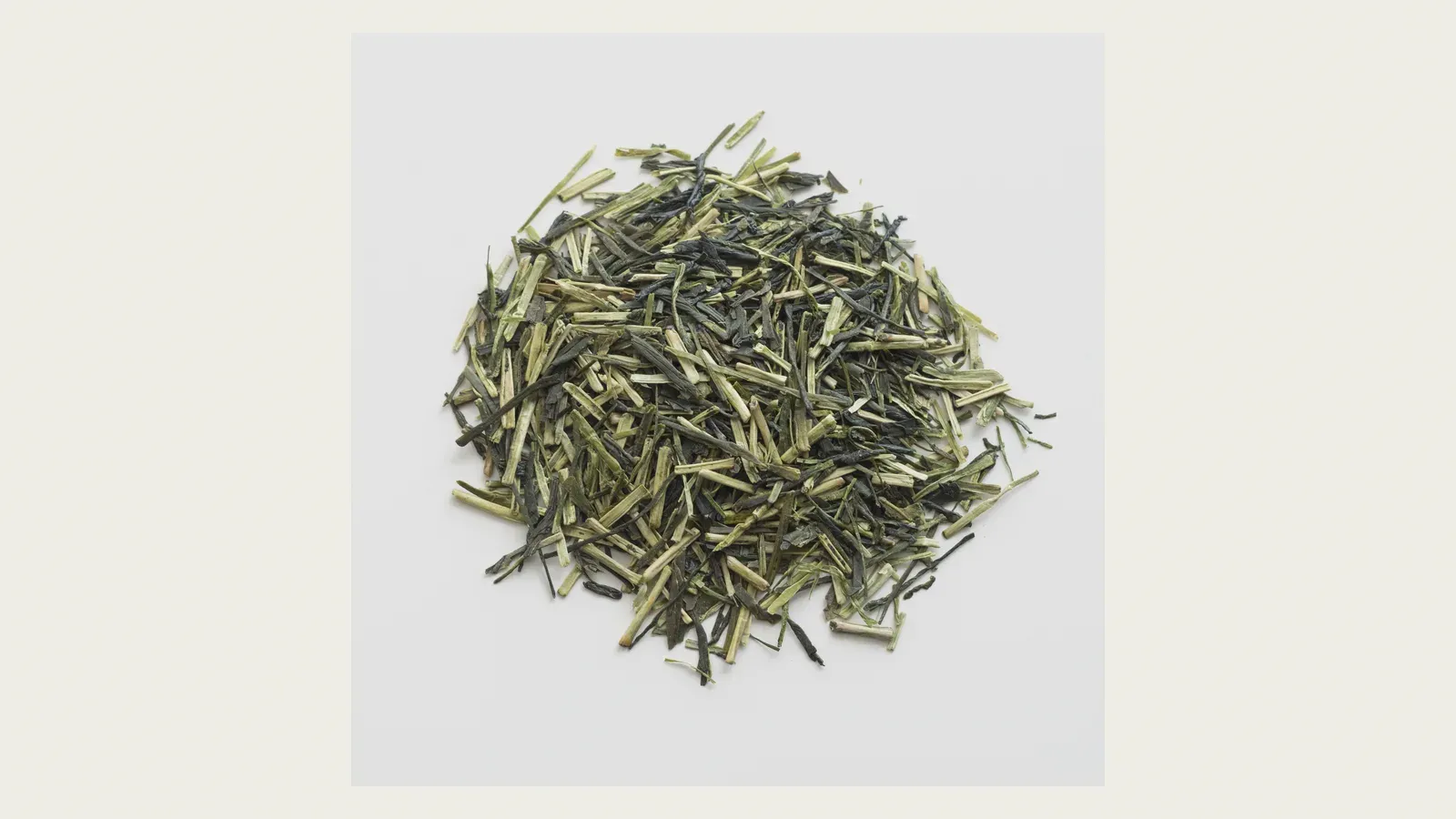
Kukicha is Japanese green tea made from the stems and leafstalks that a sorting machine pulls out of the leaf during refining. Japan’s labelling standard defines it by that machine and treats kukicha and bōcha as one name. Karigane, the premium word, appears in no standard at all. Stems carry three to nine times the theanine of the leaf beside them and less caffeine, which is why the cup is sweet. Brew ordinary kukicha near boiling.
The Green Tea Labelling Standard of the Japan Tea Central Public Interest Association names seventeen kinds of tea. Sixteen of them describe a leaf, or an operation performed on one. Entry eleven describes a machine.
茎茶又は棒茶 — kukicha (茎茶), or bōcha (棒茶): “tea containing many of the stems and leafstalks of tea, sorted out by a stem separator or the like during the refining process of aracha” 1.
The machine is the mokkei bunriki (木茎分離機), the wood-and-stem separator. It sits near the end of the line, after the crude tea called aracha (荒茶) comes in from the farm and before the finished bag goes out, and its job is to pull the twigs out of the needles. Everything else about this tea follows from what that machine is for.
What the separator takes out
It takes out stems and yōhei (葉柄), the leafstalks — the short stalk joining a leaf to the shoot. Ippodo describes the raw situation plainly: a sencha leaf arrives from the field still clinging to the soft stem it sprouted from, and processing splits the two apart 11.
Read entry eleven once more and notice the hedge. Tea containing many stems and leafstalks 1. The standard declines to say a bag of kukicha is all stem, and the Global Japanese Tea Association agrees: kukicha is mostly stems, with some leaf still in the mix 6.
Kukicha has two siblings in the standard, and the three of them are defined the same way. Entry nine, konacha (粉茶): the powder sifted out in refining. Entry ten, mecha (芽茶): the bud tips sifted out in refining sencha or gyokuro 1. Sencha is what the standard says you made. These three are what fell off the sieve while you made it. The Japanese trade calls them demono (出物), the sortings, and files bancha alongside them.
Now the part that decides everything downstream. The GJTA gives the reason the stems come out: to make the leaf teas uniform and better-looking 6. A tight dark needle is what a buyer of sencha is paying to see, and a pale twig lying across the pile spoils the look of it. So the separator is, in its origins, a cosmetic machine. It removes a part of the shoot on the grounds that the part is the wrong shape.
Set that beside the tea room, where a bowl is admired for the very irregularity a factory would reject, and a break repaired in gold makes the piece more valuable than it was whole. The refining line runs on the opposite instinct. It sorts for sameness.
Karigane, shiraore, bōcha
Here is where most write-ups go soft, so take the sources one at a time.
ITO EN, whose tea encyclopedia is about as mainstream as Japanese tea reference gets, defines kukicha as the stems of new shoots extracted by a sorting machine during the refining of gyokuro or sencha, and says that the premium ones — off high-grade gyokuro or sencha — “are called karigane and prized” 4. Kodansha’s beverage dictionary defines karigane (雁ヶ音, “the cry of the wild goose”) as premium kukicha, using stems separated during the production of “gyokuro and the like” 5. That hedge is the dictionary’s, not mine.
English sources push further. Karigane historically meant kukicha made from gyokuro leaf, and the term “has become diverse, and is also used for any kukicha of high quality” 78.
Then the map. In Kyushu the same tea is called shiraore (白折) — Kyoto says karigane, Kyushu says shiraore, and the tea is the same tea 9. Wikipedia states the rule from the other end: karigane specifically from Kyushu is shiraore 8. Both names cover stem tea made from high-grade sencha and from gyokuro alike 9, so a Kyushu shiraore may be either, and the regions map the districts that argue about it.
So: the strictest sense of karigane is gyokuro stems. The working sense, the one ITO EN and the dictionary and the Kyushu trade use, is stems off gyokuro or high-grade sencha. The loosest sense is any good kukicha. All three are in live use, and the honest answer to “which is correct” is that the usage varies and always has.
There is no standard anywhere in Japan that defines karigane. I extracted the full text of the labelling standard to check: 雁ヶ音 appears nowhere in it, nor does 白折, and the supplementary table of permitted names outside the main list runs only to shincha, kocha and the numbered harvests 1. The committee that regulates whether a bag may call itself 極上 has never troubled itself with karigane, because karigane is not a grade. It is a compliment.
ITO EN’s distinction is the one that matters and the standard is blind to it. Tender stems off a hand-picked first flush and coarse machine-cut sticks both satisfy entry eleven. The market’s premium word is unregulated, and the market’s real quality signal has no official name at all.
Why the stem is the sweet part
The chemistry here is better than the folklore, and it has been measured.
Theanine, the amino acid that carries sweetness and umami, is made in the tea plant’s roots, mostly in late autumn and winter. In spring it moves up into the new shoots through the xylem 2. What happens when it arrives is the interesting part. A 2025 paper in Plant Physiology puts it in one line:
Theanine … is primarily synthesized in roots of tea plants and transported to new shoots, where it is mainly distributed to the young stem; however, tea is predominantly produced from young leaves.
The stem is where the theanine goes, and the leaf is what Japan sells. Measured across eleven cultivars, the theanine ratio between the first stem and the first leaf of a new shoot ran from 3.3 to 8.8 times in the stem’s favour 2. A transporter protein called CsCAT1, sitting in the stem’s vascular tissue, does the holding: express it strongly and theanine stays in the stem, knock it down and more of it reaches the leaf 2.
Two caveats, because this is the claim vendors inflate. Those measurements are of the fresh shoot, not of the bag on your shelf, and a bag holds thicker stems than the paper’s first stem. The numbers explain the direction of the flavour. They do not survive being restated as a fact about your cup.
The other half of the trade runs the opposite way. Comparing stems and leaves of matched tenderness in a Chinese green tea, caffeine, total polyphenols and total catechins all came out significantly higher in the leaves, while total free amino acids came out higher in the stems 3. That study is Lu’an Guapian from Anhui rather than yabukita from Uji, so read the direction and leave the decimals alone.
Put the two together and kukicha’s whole character falls out. The sweet compound concentrates in the stem. The bitter and stimulating ones concentrate in the leaf. The separator divides the shoot along almost exactly that line, and then the industry prices the sweet half at a discount because it is the wrong shape.
Shading is a second, separate lever on the same chemistry — sunlight converts theanine into catechins, so twenty days under cover leave the leaf loaded with it, which is the whole argument of gyokuro. A gyokuro karigane gets both effects at once: shaded plant, and the stem of it.
The number nobody has
Japan measures its teas. The national Standard Tables of Food Composition give caffeine and tannin per 100 grams of infusion for gyokuro, sencha, kamairicha, bancha, hōjicha and genmaicha, each on a stated reference brew.
They carry no entry for kukicha. None for karigane, bōcha, mecha or konacha either 12. The three teas the separator makes are absent from the country’s own composition tables.
So the honest position on kukicha’s caffeine is that it is low, well-supported in direction, and unmeasured by anyone with authority. A Japanese tea seller writing a whole page on the question ends up saying that hōjicha runs about 20 mg per 100 g and kukicha is presumed lower 10 — 推測されます, the verb doing the work. When a shop with stock to move declines to give you a number, believe the absence. If you want a figure you can lean on, the measured ones sit in matcha, caffeine and L-theanine.
How to brew it
The sources split, and the split is instructive.
| Source | Tea | Leaf | Water | Temp | Time |
|---|---|---|---|---|---|
| Ippodo 11 | Stems sencha | 10 g | 240 mL | 100°C | 30 s |
| Japanese Tea Pedia 7 | Kukicha | 4 g | 200 mL | 70–80°C | 30 s |
| CHANOYU 10 | Kukicha | ~5 g | — | ~80°C | 40–60 s |
| CHAKATSU 9 | Shiraore / karigane | — | — | 70–80°C | — |
Three guides say 70–80°C. The Kyoto house that has been refining this material since 1717 says boiling 11.
Follow Ippodo. The 70–80°C rule belongs to sencha, where cool water exists for one purpose: to leave the bitter catechins in the leaf while the sweet theanine comes out. Run that reasoning on a stem and it collapses, because the catechins that the rule protects you from largely stayed behind in the leaf the separator threw this twig out of. The GJTA is blunt about the consequence — boiling water for several minutes will not make kukicha too bitter 6. Cool water on ordinary kukicha guards against a bitterness that was never in the pot, and costs you the aroma that heat would have lifted. It is sencha’s discipline, applied by reflex to a twig.
One exception, and it is the expensive one. Brew a gyokuro karigane at 70°C or a little below 9. You bought that tea for thickness and sweetness ahead of fragrance, and cool water brings the sweetness forward. Ordinary kukicha wants a kettle. Gyokuro karigane wants the patience you would give the leaf it came off.
Both re-steep, and neither goes far. Flavour drops off sharply by the second infusion 7, which is what you would expect of a material that gives everything up in thirty seconds. Every other Japanese tea and its numbers are in the temperature and time guide.
The roasted branch
Roast kukicha and it becomes something else. Stem-based hōjicha brews lighter and sweeter than the leaf-based kind and sits lowest of all in caffeine, and the famous one is kaga bōcha (加賀棒茶) from Kaga in Ishikawa. That tea, its 1902 origin and the chemistry of what a roaster does to a leaf belong to hōjicha, which is built on the question. Note only where the boundary runs: kukicha is the raw material, and the roast is a separate operation the standard defines separately 1.
What to buy
Ignore the word karigane. It is unregulated, it means three different things depending on who printed it, and it is the one word on the bag nobody can be held to.
Read the base instead. “Gyokuro kukicha” and “sencha stems” are claims about raw material that a seller can be challenged on. Ippodo prints exactly that and never reaches for the romance: its stem tea is sold as Stems Sencha, “a type of kukicha”, off the same highest-grade leaves as its sencha 11. A house with three centuries of reputation would have every commercial reason to write karigane on the packet. It writes the leaf.
Then look at the stems. ITO EN’s tell is that the glossier and brighter green they are, the sweeter the tea, while thick reddish-brown sticks mark the machine-harvested end of the category 4. That is the distinction the standard collapsed into one entry, and you can see it through the bag before you pay.
Which brings me to what I think this tea is. A gyokuro karigane is the stem of the most expensive leaf in Japan, off the same shaded bush, cut on the same day, holding several times the theanine that the leaf beside it held — sold cheaper because it came out of the sieve rather than the sencha. The trade files it under demono, the stuff that fell out. The plant files it under where the sugar went.
The separator has been sitting in entry eleven since April 1991, through every revision to July 2026 1. It was installed to make the leaf look like leaf. What it has been quietly doing for a century is dividing each shoot into the part Japan sells and the part Japan drinks — and among the seven teas, it is the only one whose existence is an accident of tidiness.
Sources
12sources日本茶業中央会 (Japan Tea Central Public Interest Association), 緑茶の表示基準 / Green Tea Labelling Standard
SupportsEstablished 1 April 1991 (平成3年4月1日制定), last revised 10 July 2026 (令和8年7月10日改正). 実施細則 表1 no.11 茎茶又は棒茶: 「荒茶の仕上げ工程で木茎分離機などで選別された茶の茎や葉柄を多く含む茶をいう」 — defined by the sorting machine, and kukicha/bōcha given as one entry. Adjacent sortings: no.9 粉茶 「仕上げ工程でふるい分けされた粉末状の茶をいう。荒粉、切断された葉を含む」; no.10 芽茶 「煎茶や玉露の仕上げ加工の工程で篩分けされた芽先のもの」. For contrast: no.1 煎茶 「茶葉を蒸熱、揉捻、乾燥して製造したもの」; no.7 番茶又は川柳; no.13 ほうじ茶 「煎茶や番茶などを強い火で焙って製造したもの」. Verified by extracting the PDF text directly: neither 雁ヶ音 nor 白折 nor かりがね appears anywhere in the document, and 表2 (names outside table 1) lists only 新茶・古茶・春番茶・一番茶・二番茶・三番茶・四番茶・秋番茶
Zhang et al., 'CATIONIC AMINO ACID TRANSPORTER 1 modulates amino acid distribution between stem and leaf in new shoots: A case study of theanine distribution in tea plants (Camellia sinensis)', Plant Physiology 198(3), 2025
SupportsDOI 10.1093/plphys/kiaf255. Abstract, verbatim: theanine 'is primarily synthesized in roots of tea plants and transported to new shoots, where it is mainly distributed to the young stem; however, tea is predominantly produced from young leaves.' Stem-to-leaf theanine ratio ranged 3.3–8.8 across 11 cultivars (up to 2.7-fold difference between varieties); material measured is the first leaf and first stem of fresh new shoots, not processed tea. CsCAT1 is a plasma-membrane transporter expressed in stem vascular ray and phloem parenchyma cells; high expression retains theanine in the stem, and knockdown raises leaf theanine
Zhang W., Guo W., He C., Tao M., Liu Z., 'Exploring the Quality and Application Potential of the Remaining Tea Stems after the Postharvest Tea Leaves: The Example of Lu'an Guapian Tea (Camellia sinensis L.)', Foods, 2022
SupportsLu'an Guapian tea from Mabu Town, Jinzhai County, Anhui Province, China — a Chinese green tea, sampled mid-May 2021, stems and leaves of matched tenderness. Verbatim: 'the water extract, total polyphenol, caffeine, EGC, EGCG, ECG, nongallated catechin, total catechin, and water-insoluble ash content of the leaves was considerably higher than that in the stems (p ≤ 0.05)' and 'the total free amino acid, crude fiber, C, EC, water-soluble ash, and ash content of the stems was higher than that of the leaves (p ≤ 0.05)'. The accessible text reports direction and significance rather than tabulated mg/g values, so no decimals are quoted from it
ITO EN, お茶百科, '茎茶・芽茶・粉茶'
Supports茎茶: 「玉露や煎茶の仕上げ加工工程で、選別機によって新芽の茎だけを抽出したお茶です」, with 「独特のさわやかな香りと甘み」. Premium stems from high-grade gyokuro or sencha are 「かりがね」と呼ばれて珍重されています; glossier, brighter green stems indicate greater sweetness. 棒茶: reddish-brown thick stems arising from machine harvesting are 「地域によっては『棒茶(ぼうちゃ)』として販売されています」 — i.e. ITO EN separates fine new-shoot kukicha from thick bōcha, where the labelling standard makes the two words one entry
Kotobank / 講談社『飲み物がわかる辞典』, '雁ヶ音'
SupportsDictionary definition, verbatim: 「茎茶の高級なもの。玉露などの製造過程で分離した茎を使用する。うまみ成分テアニンを多く含み、渋みの少ない味わいが特徴。」 Note the hedge 玉露など — 'gyokuro and the like' — the dictionary itself declines to restrict karigane to gyokuro stems alone
Global Japanese Tea Association, 'Kukicha (茎茶)'
Supports'Kukicha started as a byproduct of Matcha, Gyokuro or Sencha production'; stems were removed to make the leaf teas more uniform and visually appealing; 'Kukicha mostly includes stems, but occasionally you can find some tea leaves in the mix too'; three stem parts named — bou (base stem), kuki (connecting stem), youmyaku (leaf veins); regular kukicha reads sea-like and mineral, roasted kukicha woody and sweet-vanilla; 'Even brewing with boiling water for several minutes wouldn't make it too bitter'; works well cold-brewed; page makes no mention of karigane or shiraore
Japanese Tea Pedia (japanesetea.sg), 'The Ultimate Guide to Kukicha and Karigane'
SupportsKukicha from 'small stems, stalks and twigs'; karigane 'historically referred to Kukicha made from leaves used for Gyokuro green tea. However, these days the term Karigane has become diverse, and is also used for any Kukicha of high quality'; shiraore given as an alternative name for karigane depending on location of manufacture; brewing 2 tsp (4 g) per 200 mL at 70–80°C for 30 s, flavour falling off sharply on the second infusion; bōcha described as roasted kukicha, famous in Kanazawa, Ishikawa. Claim that theanine is 'double the amount in the stems and twigs as compared to in leaves' is uncited and is superseded here by the Plant Physiology measurement
Wikipedia, 'Kukicha'
Supports'A Japanese tea blend made of stems, stalks, and twigs of the tea plant', also known as bōcha (棒茶); karigane originates from gyokuro's production and 'these days the term karigane has become diverse, and is also used for any kukicha of high quality'; 'Karigane that is specifically from Kyushu is called shiraore'. References are vendor sites and the George Ohsawa Macrobiotic Foundation — no scientific sources — so used here only for naming usage
茶活 CHAKATSU, '【白折茶、雁が音茶】とは?'
Supports「『白折茶』『雁が音茶』は、どちらも茶の「茎」の部分を集めて作られたお茶ことで、一般的には「茎茶」と呼ばれる日本茶の一つです」; regional split stated as 「主に九州だと『白折茶』、京都では『雁が音茶』と呼ばれています」; both made from 上質な煎茶や玉露; grouped with 芽茶 and 粉茶 as 出物 (sortings/by-products); 「直接日光があたりにくい茶の『茎』には…『テアニン』も多く含まれています」; 「渋みや苦みは少なく、さっぱりした中に甘みと旨味があります」; brewing 湯温70度〜80度, first infusion at 70°C or below if two steeps are wanted
CHANOYU (e-cha.co.jp), '茎茶の特徴や入れ方|カフェインはどのくらい含まれている?'
Supports茎茶 = 「日本茶を製造する工程ではじかれた茎部分を使ったお茶の総称」; 「かりがね・白折(しらおれ)・棒茶(ぼうちゃ)は、全て茎茶を指す別称」, karigane originally a Kyoto term for premium stems, shiraore used in parts of Kyushu; 「チャノキのなかで最もテアニンを含むのは、茶葉ではなく茎部分です」; on caffeine: 「ほうじ茶では100gあたりに含まれるカフェイン量は20mgとされていますが、茎茶の場合はさらに少ないと推測されます」 — note 推測 (presumed), i.e. a Japanese seller conceding no measurement exists; brewing ~5 g per serving, ~80°C, 「40〜60秒ほど蒸らします」
Ippodo Tea (Kyoto since 1717), 'Stems Sencha (Kuki Sencha), 80g Bag'
SupportsSold as 'Stems Sencha (a type of kukicha)' — the word karigane appears nowhere on the page. 'A regular Ippodo sencha is made from just the highest grade leaves of the tea plant. Right after harvesting, these leaves cling delicately to the soft stems that they sprouted from. Then, during processing, the stems and leaves split off and are separated from each other.' Flavour: 'a classic balance of sweetness, umami, bitterness, and astringency… its crisp, snappy taste and its fragrance make it distinct from a regular leaf sencha.' Brewing: 2 tbsp (10 g) leaf, 240 mL water, 100°C (212°F), 30 seconds
MEXT, Standard Tables of Food Composition in Japan, ch. 3 §16 (し好飲料類)
SupportsChecked for a kukicha entry and found none. The green tea items defined are 16033 玉露 茶, 16034 玉露 浸出液, 16035 抹茶, 16036 せん茶 茶, 16037 せん茶 浸出液, 16038 かまいり茶 浸出液, 16039 番茶 浸出液, 16040 ほうじ茶 浸出液, 16041 玄米茶 浸出液. 茎茶, 雁ヶ音, 棒茶, 芽茶 and 粉茶 are all absent — Japan's national composition tables carry no caffeine or tannin figure for stem tea
Image: Difference engine, Wikimedia Commons · CC BY-SA 4.0
Common questions
Is karigane the same as kukicha?
Karigane is a kind of kukicha, and no standard says which kind. Japan's Green Tea Labelling Standard defines 茎茶又は棒茶 — kukicha or bōcha — and never mentions karigane. In practice the word marks the good end of the category. Kodansha's beverage dictionary defines karigane as premium kukicha using stems separated during the production of gyokuro 'and the like', and ITO EN reserves it for stems off high-grade gyokuro or sencha. Some writers now apply it to any high-quality stem tea. The strictest sense is gyokuro stems, the working sense is gyokuro or high-grade sencha stems, and nothing enforces either.
Does kukicha have less caffeine than sencha?
Almost certainly, though Japan has never measured it. The national Standard Tables of Food Composition give infusion figures for gyokuro, sencha, kamairicha, bancha, hōjicha and genmaicha, and list no entry for kukicha at all. What is measured is the plant: leaves run significantly higher than stems in caffeine and catechins, while stems run higher in free amino acids. So the direction is well supported and the milligram figure does not exist. A Japanese tea seller writing about kukicha's caffeine says only that it is presumed lower than hōjicha's.
What temperature should I brew kukicha at?
Hotter than most guides tell you. The common advice is 70–80°C, borrowed from sencha, where cool water exists to hold back bitter catechins. Stems carry few catechins, so there is little to hold back. Ippodo, in Kyoto since 1717, brews its stems sencha with 10 g of leaf in 240 mL of water at 100°C for 30 seconds. Save the cool water for a gyokuro karigane, where you are chasing sweetness rather than aroma, and start that one near 70°C.